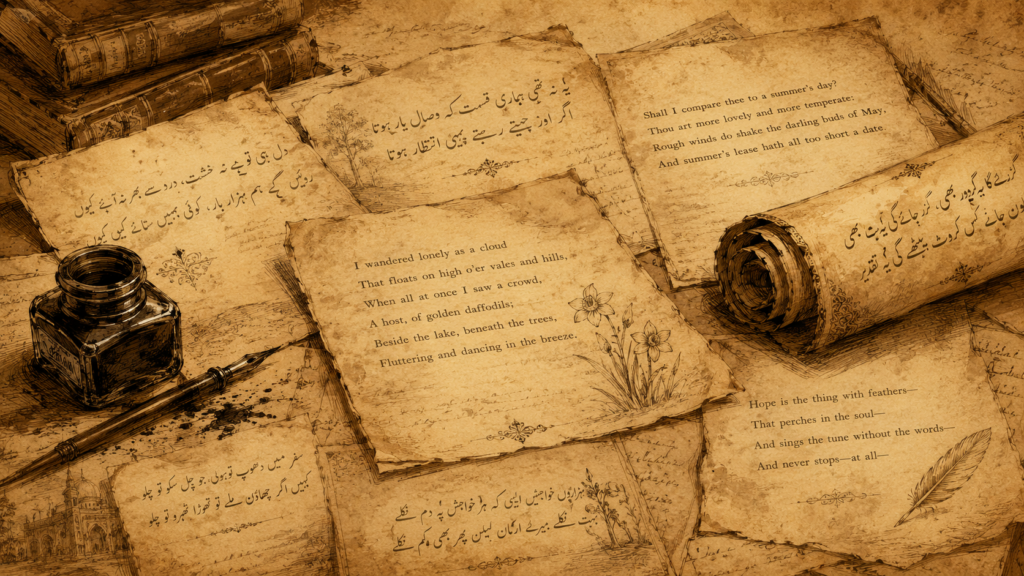
One of the many things that I inherited from my father was his love for poetry, specifically Urdu Ghazals. Poetry appears in many forms: poems, ghazals, nazms, sonnets, odes, elegies, ballads, free verse, etc. Personally, I love anything that rhymes.
Poetry is quite powerful as well, if you get the hang of it. When I am able to connect with the seemingly un-seeming words of a poem, I am hooked. It feels like magic as it makes me start looking at the world in a different light. No wonder Poets were both chastised and cherished by powerful governments right through history, just because poems have the ability to stir the masses. Our own Allama Iqbal is rightly credited with instilling a sense of unity and belonging in our struggle to form a country for the Muslims of the subcontinent.
The beauty of poetry, whatever language it may be in, is that its real meaning is often hidden behind layers, which one has to peel back to reach the heart of it.
So over time, I developed a simple method to understand poetry.
1. Read the poem. ‘Duh. That’s so original!’ you might say. But the reason I mention this is that you might get frustrated because the words are too difficult, OR you don’t understand the meaning or context. Don’t worry, that is normal. Just keep reading and finish the poem in one go.
2. Highlight the difficult words and find their meanings. In the age of AI, you can find the meanings very quickly. I normally take a picture and put it in Gemini and ask it to give me the meanings of the difficult words. I do still highlight those words and write their meanings inside the book. It saves me going back and forth between the book and Gemini during my multiple re-reads.
Read the poem again. At this point, the first layer should be removed, and the literal meaning would be surfacing.
3. Find the hidden meanings. This is where the magic lies, and it requires a little bit of effort. I call this as ‘finding the meaning of the meaning’ or what the poet actually means. This step is important and would need a little bit of research on the poet and his worldview.
Because great poets do not write about just anything. They write about things that matter the most to them. Things that make them emotional. So to peel this layer and get to the hidden meaning you would have to find answers to some questions about the poet like ‘the times the poet lived in’, ‘what were some issues that society was facing at that time’, ‘what were some issues that the poet was going through’, ‘what did the poet normally write about?’, ‘what was his world view’, ‘what images or styles did he normally uses’.
Again, Gemini is a great time saver here. And normally, you would have to do this once for one poet. Because things that matter to great poets normally do not change in their lifetimes. Also, a poet hardly changes his style, e.g., a poet may use nature to explain his take on life. ,
Note that you might not agree with the poet’s worldview, but it is still important for you to understand where he is coming from.
These three steps are most important, and let us study them with an example.
e.g.
The Woods are lovely, dark, and deep
But I have promises to keep
And miles to go before I sleep
And miles to go before I sleep
Here, the literal meaning can be that the poet likes the woods and likes to watch them. But he has some other work and wants to do that.
But this literal meaning is not very magical. Is it? So we have to ask some questions about the poet. Robert Frost loves nature. His poems, at least the ones I have read and loved, are all about nature. But he also relates them to life and choices in life.
So if you understand Frost’s style, you might peel the next layer and see that by ‘woods’ he means the ‘world with all its attractions’, and by ‘promises’ he means ‘responsibilities’ and by ‘sleep’ he means ‘death’. So the meaning of the meaning becomes that although he loves many things that the world has to offer, he has many responsibilities that he needs to fulfil and cannot ignore. And these responsibilities are so many that he denotes them by ‘miles’. And perhaps it would take a lifetime to fulfill them. But maybe somewhere along the way, he would find some other attractions like this and would just pause for a while to enjoy them, and then he would move again.
This is what I mean about finding the meaning of the meaning.
If you want, you can stop here. But I have a few more steps.
4. Find your meaning. You don’t need to go with what the poet probably meant by his poem. Poems, Ghazals, and Nazms are so full of options that you can draw your own meaning. For example, in the lines above, I like to draw a meaning that connects with my own being and its relationship with my Creator — the magnificent Allah Almighty — and with the attractions that Allah Himself has placed in this world for us.
If I use these attractions to pause for a while, enjoy them, and re-energize myself, then they are helpful. But if I allow them to make me forget my responsibilities and the purpose of my life, then I am at a loss.
5. Listen to a good orator so that you can know how to recite the words with correct pronunciation and weight. I love doing that. Because it helps me read with emotions.
6. Finally, read it many times and also explain it to others. Often, I explain a new Ghazal or poem that I have decoded to my kids or my wife. Sometimes the expression on their faces, when they get to know the actual meaning, is priceless. Many times, they explain the meanings that they understood to me, which I love even more. Most importantly, this helps me memorize the poem.
Well, that is it for today. I will leave you with a poem by Robert Frost, and you let me know in the comments your meaning!
Nature’s first green is gold
Her hardest hue to hold
Her early leaf’s a flower
But only so an hour
Then leaf subsides to leaf
So Eden Sank to Grief
So dawn turns down to day
Nothing Gold, can stay.
Enjoyed reading? Join my WhatsApp Channel for daily updates and let me know what you think.