How can I instill this in the hearts? My heart desires that everyone comes to the right path in such a way that the glory of Islam is manifested from their every action, just as people used to accept Islam by observing the respected Companions (Sahaba-e-Karaam); We should all adopt the Sahaba as our role models. The betterment of this world and the faith is hidden within this.
It is a factual matter that if Muslims reform themselves and religion becomes firmly rooted in them, then and only then can Islam be established. Whatever worldly calamities are swarming us nowadays, Insha’Allah (God willing), the situation will completely turn around in a few days. And although there can be intellectual arguments for this, I wish I could reveal the experiential (spiritual/inner) portion of it, but I do not have the power to express it.
Notes to myself
After listening to numerous lectures from Ulema-e-Karaam, my belief has been strengthened: I have to change myself and align my surroundings (my own personal being, my home, and my office) with the teachings of Islam rather than someone else to do it for me.
I realized that the answer to the question ‘When would Islam become a power again?’ is not that “they” (the people, the government, the army, the bureaucracy, etc.) have to change; the answer is that “I” have to change. This change will not come through bullets or force; it will only come when we change ourselves.
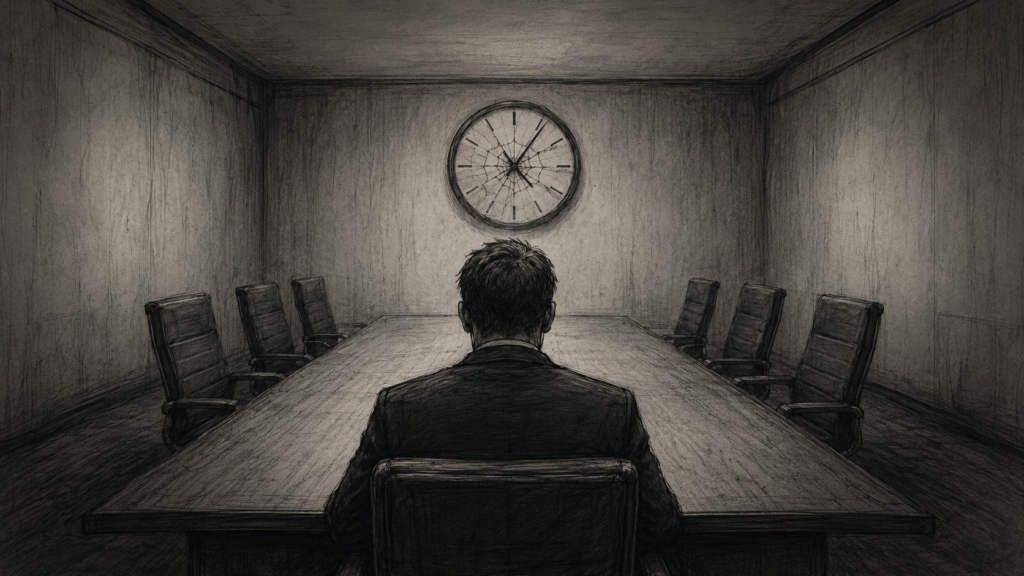
He walked into the meeting room, followed by his men. Some stayed outside guarding the door, while others accompanied him inside. The table in the center of the room was already full except for the chair at the head of the table, which he took immediately. Putting his elbows on the table, he ordered
‘Let’s start’
A few people at the table scrambled to load the slides on the main screen. He was not interested in the preliminary briefing. He looked up at the wall in front of him at the clock.
Tick. Tick. Tick. Tick.
He told them to jump directly to the numbers, which his team did immediately. Proud smiles on their faces. There were just two numbers on the slide.
70,000 killed. 33,000 children.
He moved his elbows from the table and relaxed his back on the chair. A smile entered on his lips. He looked away from the slides. But his eyes went back to the clock.
Tick. Tick. Tick. Tick.
He forced the sound aside, adopted a business-like tone and addressed the men at the table.
‘These are very good numbers. Better than what we planned for the week. Well done! How is the media being handled?’
‘Contained, Sir’, said a man in the suit, ‘Their silence already bought. ‘ A few voices here and there, but we are successful in numbing them down with crap’.
He looked towards his foreign minister and raised his eyebrows
‘The usual, Sir, ’ he said, smiling. ‘All governments are compliant. Controlling protests, condemning us in public, giving us thumbs up in private, ’ he raised both thumbs as he said it, his two front teeth jutting out like a rabbit’s.
Ugly, thought the man. But good at his job.
The man was happy and looked satisfied. But the clock, he noticed, kept on ticking.
Tick. Tick. Tick. Tick.
He forced the sound aside again and smiled to his team.
‘Someone said that they had a surprise for me’
Everyone looked at each other and smiled. Sir, a special video for your birthday. Someone clicked on the remote and a video started playing.
Soldiers were firing at civilians. Men, women, and children were falling like dead leaves. Finally, when no civilian was remaining, a soldier bravely walked up to one of the corpses and dragged a child out of his dead mother’s protective arms. The child was alive. The child tried to run. But another brave soldier timely shoots at his feet. The child fell but started to drag himself towards safety, which didn’t exist. The brave soldier who had released the child from his mother’s arms walked up to the child, and puts a gun to the child’s head, and looked bravely into the child’s eyes. The child didn’t know what was happening or was going to happen. The brave soldier solved the puzzle and shot him twice. Life went out of the child’s body like a cool breeze blowing from east to west.
The man at the head of the table started clapping.
‘Bravo. Bravo,’ he yelled. As if his favorite team had just scored a goal.
Everyone in the meeting room started clapping with him. As the clapping died down, the man sat back on his seat. He felt powerful. And no one, no one was able to stop him.
‘No one will ever be able to stop me, ’ he thought to himself. He sat back on his chair.
‘A job well done, gentlemen. But this isn’t over. Next week, I want these numbers doubled’
Everyone nodded excitedly as they started to leave the room and prepare for the next week.
The room grew silent. He looked at the clock again.
Tick. Tick. Tick. Tick.
“What are you looking at?” he asked the clock mockingly. Then he smiled cruelly. “The most powerful man in the world?”
“No,” said the clock. “You are not.”
He looked up slowly.
“Oh? And who, exactly, stands more powerful than me today?”
“It is I. Your humble friend. Time. The most powerful. Today. Yesterday. Tomorrow. I am the most powerful being God has created in this world”
“You?” He gave a short laugh. “You hang on a wall all day.”
“True,” said the clock. “That is probably why men like you spend their whole lives pretending I am not there. Until I am the only thing left.”
His smile remained, but only barely.
“What do you mean?”
The clock took the shape of a man and began walking slowly towards him. The man panicked. He was about to call for his guards when the clock spoke.
“Don’t call them. They will only think you have gone mad. And then your end will come sooner than you think. I will not hurt you. Not yet, anyway.”
“I am not afraid of you,” the man said, his palm turning into a fist. “I control you.”
“No,” said the clock, tilting its head. “You don’t.”. And then it leaned closer.
“I. Control. You. And many men like you.”
The clock walked up to him, patted him lightly on the head, then on the shoulder. Then it pulled out a chair and sat beside him, close enough for the man to hear the ticking from inside its chest. The same dreaded ticking he has been trying to force away from his mind.
“See, you are a proud man. Cruel, yes. But proud. You are pleased with yourself because you have killed thousands. But tell me, do you know how many I have killed? Millions.
Millions upon millions.
You kill with a button. From a distance. Most of your victims do not even see you coming. They do not even have time to understand their pain.
Except that poor child, perhaps, who had just a few seconds.
But I am not like you. I do not kill in an instant. I wait. I watch. I take things away slowly. Your strength first. Then your sleep. Then your pride. Then your mind.
You will beg for death. But death will not obey you. Death will look towards me, its master, and ask me, ‘Is it time?’
You may put a gun to your head and pull the trigger. You may swallow every pill in your palace. But even then, it will not be you who decides. I will choose when you die. Me.”
The man was visibly shaken, but he forced out a nervous laugh.
“You are just a clock,” he said. “Tick. Tick. Tick. That is all you can do.” He tried to look brave. But he knew. Somewhere deep inside, he knew.
“Ah,” said the clock. “There it is. The brave face.” It leaned closer.
“But I can see behind it. I can see your eyes. Your heart. Your mind. Even the darkness in your soul.” The clock paused.
“I can smell the fear in your sweat. I can see it in your trembling hands, in your pinched brow, in the way your breath catches before every word.” It smiled.
“You are afraid. Terribly afraid.
And you should be.”
“Why should I be afraid?” he asked, trying to sound relaxed.
“Because you know your end very well,” said the clock. “You are a literate man. You have read history. You know what happens to men like you. One day, you will retire. Or you will be removed. Surely you will be replaced. And then you will lose everything.
Soon, another man will sit in this chair. Another man who will believe that he is the most powerful man in the world. Perhaps he will come for you. Perhaps he will not.
But I will.
I will come for you, my dear friend. In fact, I will never leave you. You will be sitting with your family. Playing with your children. Bathing. Swimming. Eating. Laughing. Even making love. Whatever you are doing, I will be there. With you. Inside you. Inside your brain.
Ticking. Tick. Tick. Tick.
Slowly at first. Then louder and louder. You will try to silence me. But fail. You will try to fight me. But fail. You will try to drown me, in drink, in drugs, in anything that can cloud your mind. But fail.
I will keep ticking. I will keep eating you from inside. You may escape the courts. You may escape the mobs. You may escape the men who hate you. But you will not escape me. Because I am your friend.
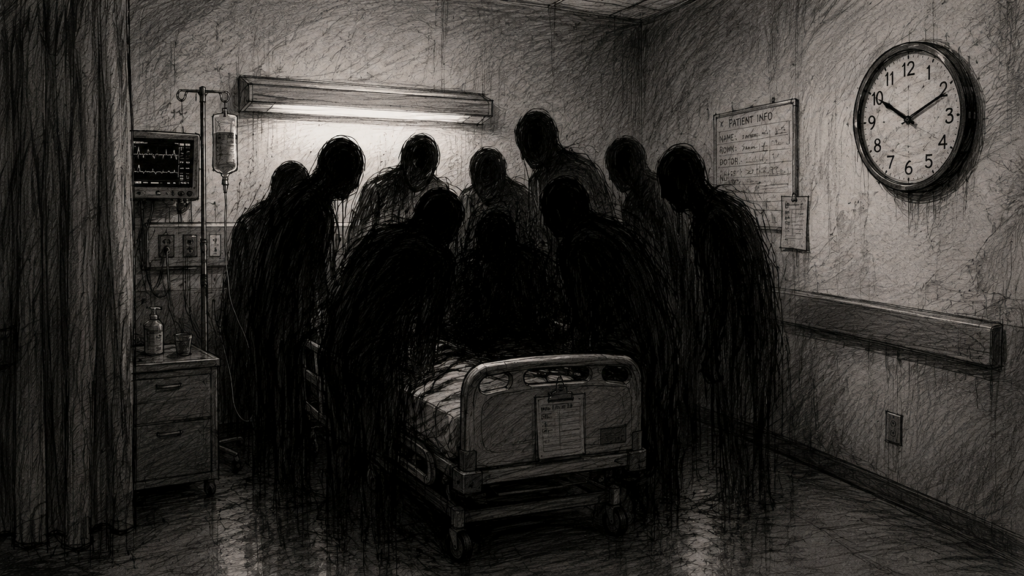
Little by little. I will take your strength. Then your sleep. Then your peace. I will dim your eyes. Dull your ears. Crack your bones, one by one. I will make every breath feel borrowed. And when the end comes near, you will know it. Because you would be able to see them.
‘Who?’ he asked, trying to drink water from the glass in front of him, but the glass was empty. His throat was dry.
All the ones you have killed. They will begin to visit you. Eager. Waiting. Almost joyful. At first, only in dreams. And then, outside of them. They would be right there in front of your eyes. No one else can see them except you. They will stand there, looking at you, straight into your face, into your eyes”
“I did what I need to do.”, he said, growling.
“Oh, and surely I will do what I need to do,” said the clock.
“I will command death to become an itch inside your body. You will scratch and scratch, but you will not be able to reach it. You will feel helpless. Just like that child. And then, then you will see them.
Dark men, with dark faces, and dark shadows – making everything dark around them. Everything inside and outside of you will become sombre and black.
And then they will pull your soul from your body. It will feel like wet wool caught in thorns being dragged through your veins. You will scream, but no one will hear you. You will weep, but no one will see your tears. And then do you know what will happen?”
“I will die. ‘Everyone has to die. And so will I’”
“No,” said the clock. “No. No. No. That is where all of you are wrong.
You will not die.
Your death will die.
Do you understand that? Your death… will die!
You, on the other hand, will live forever and ever. People will mourn your passing. Perhaps they will give you a grand funeral. Perhaps they will write your name in history. But you will not be dead. You will be alive. More alive than you have ever been. And then your punishment will begin.”
The man looked nervously at the clock.
“Death will not end your pain. In fact, your suffering will only begin. Dark forces will come and beat you until there is almost nothing left of you. Then you will be made whole again. Not as mercy. But so the pain can begin again. They will beat you again. You will feel every blow. You will cry. You will scream. You will beg. But they will say, ‘Didn’t you know? Did no one tell you?’. And you will say…”
‘Yes. I will say Yes’
‘Good boy, ’ shouted the clock in glee and triumph, patting him on his back. ‘You will say yes. YES! Yes, my dearest friend, who was there with me from the time I was conceived till the very end, TIME, had told me. Showed me all the signs. But…’ the clock turned his fist into a mic and placed it in front of his mouth.
‘But I didn’t listen. I was proud. I wanted to feel powerful. I wanted people to envy me. Fear me.’
‘Every moment after that’, said the clock somberly, ‘your torture will only increase. The pain, the anguish, the anxiety, and most of all the sorrow. The sorrow of what you have done. The price that you have to pay for your deeds. The sorrow will eat you bit by bit. You will shout. And you will beg mercy. But no one will listen to you for centuries and centuries. Till one day, a window will open.
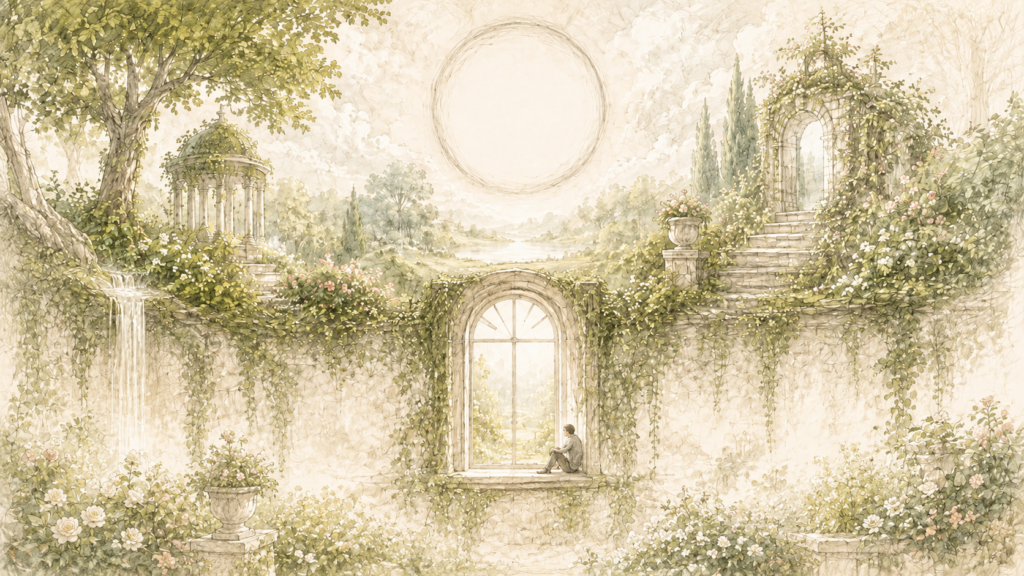
That child will look down at you from the skies, from among endless green gardens, a green so rich you have never seen its like before. And do you know what he will say?
He will say, “You thought you ended me.”
The clock leaned closer.
“But you did not. You thought you killed me. But I am alive. You thought you Won!. But you lost!
The child will say that from the day you snatched me from my mother’s dead arms was the day my trial ended and your fate was sealed. Since then, I have had nothing but peace and you nothing but anguish, sorrow and pain. I have my mother. My father. My brothers. My sisters. We eat what we want. We have all that we need. We know no fear. No hunger. No pain.
You did not destroy me. You only destroyed yourself.
The man was shaking terribly now. His throat was dry.
“You will beg them for mercy. For forgiveness. But the window will close. And you will return to the same dark fate.”
The clock leaned back in its chair. The man looked at it. But the chair was empty now.
He turned towards the front wall. The clock was there again, hanging in its place. Looking at him. Smiling at him.
“Tick. Tick. Tick. Tick,” it said.
Then it whispered, “I will catch up to you.”
The man broke. He pulled out his gun and fired. Once. Twice. And then again and again till the chamber was empty. His hands were shaking, but every shot struck the clock. The glass exploded. The frame cracked. The hands twisted. Pieces flew across the room and scattered over the table and floor.
His men rushed in at the sound of the gunshots. They found him standing there, breathing hard, his gun still raised. His face was pale. His shirt clung to his back with sweat. In the few minutes they had been outside, he seemed to have aged a hundred years. They looked from him to the shattered clock. Pieces of it lay on the floor. Pieces lay on the table. A broken part still hung from the wall.
“Sir? Is everything all right?”
The man did not answer. There was nothing that he could say. There was nothing that he could ever say again. He lowered the gun, pushed past them, and hurried out of the room. His men followed. Silently, he told himself he had killed it. At the very least, he had stopped that mocking tick-tock of the clock.
But then, from somewhere deep inside his brain, it returned. Clear. Slow. But getting louder.
The Messenger of Allah ﷺ said Befriend your friend with moderation; it may be that he will become your enemy one day. And hate your enemy with moderation; it may be that he will become your friend one day
Although the disbelievers are inherently subject to abhorrence and hatred (towards Muslims), maintaining moderation is still required even in harboring animosity towards them. Similarly, maintaining moderation in both love and hatred is absolutely essential. The jurists (Fuqaha) have gone so far as to forbid the remembrance of Allah (Zikr) when it is done inappropriately or out of place; in fact, in certain contexts, they have deemed it an act of disbelief (Kufr), such as saying “Bismillah” (In the name of Allah) over unlawfully acquired (Haram) food. In short, everything has its own designated rights and prescribed boundaries.
Our brothers (Muslims) lack the disposition for obedience and following leadership (Ittiba). Even if their commitment to faith (Deen) is not perfect, they should at least possess the capacity to follow someone. This is precisely why they are ruined.
Another reason is that they completely lack internal discipline (Nazm) and adherence to principles. If they work on combining proper organization on one hand with faith on the other—then clearly the path to divine help will open.
In the era of the Companions, what numerical strength did the Muslims possess against the Byzantine and Persian Empires? Yet, they were people of faith (Deen) and were highly organized. If proper organization accompanies faith, then see what wonders unfold! Conversely, entangling oneself in a disorganized state is to cast oneself into destruction.
And Life is a trust from God; “Do not kill yourselves” (لا تَقْتُلُوا أَنْفُسَكُمْ – Surah An-Nisa, 4:29) Sacrificing one’s life for the sake of God is no small matter, but there must at least be the satisfaction and certainty that it is undeniably being spent for God’s sake alone.
To read all the blogs on the Malfoozat of Maulana Ashraf Ali Thanvi, click here
وَمَن يَتَّقِ اللَّهَ يَجْعَل لَّهُ مَخْرَجًا. Whoever fears Allah, He brings forth a way out for him – 65:2
Taqwa, as I understand it from what I have been able to gather and retain from the discourses of our honorable Ulema, manifests in both our hearts and our actions. To the best of my limited understanding, it is a state that prevents us from not only executing anything that displeases Allah but also contemplating it.
Taqwa is not a physical or paralyzing fear, but rather a fear born of deep reverence. It is the protective anxiety of risking the displeasure of the Almighty—much like an upright person who, out of pure love and respect, would never do anything to grieve their parents.
This, as the Aayat in the Malfooz mentions, is a key to getting out of any adverse situation and, in my experience, not being in one in the first place.
To read all the blogs on the Malfoozat of Maulana Ashraf Ali Thanvi, click here
When a questioner asked a question on behalf of the general public, stating that ‘People often ask/wonder about …’, Maulana Sahab advised that such inquiries should only come from the individual who genuinely intends to act upon them. Even if someone asks, simply tell them, ‘We do not know.’
This and similar Malfoozat, discourses, and lectures from Ulema-e-Karaam have drilled into my head to focus on things that I control and not to waste time even in discussing/arguing on things that have no relevance to strengthening my relationship with my creator, Almighty Allah
To read all the blogs on the Malfoozat of Maulana Ashraf Ali Thanvi, click here
Just as the ignorant among the Sufis claimed Sharia (divine law) and Tariqa (the spiritual path) to be two separate things, thereby escaping the binding commandments and forming a permanent sect—and now they see no need for Sharia—similarly, another group has claimed Sharia and politics to be separate from each other, thereby escaping the commandments, and this too has become a permanent sect.
To read all the blogs on the Malfoozat of Maulana Ashraf Ali Thanvi, click here
One of my regular practices is to read the Malfoozat of Maulana Ashraf Ali Thanvi (رَحْمَةُ اللهِ عَلَيْه). Malfoozat, simply defined, are the casual or general words spoken by someone. They are not planned discourses (bayaans) or formal articles.
Reading them makes me feel as though I am sitting in the spiritual company of Maulana Sahab. His insights are full of wisdom, and the conversational style makes the advice deeply personal and practical to implement. I often find that just a few lines (malfooz) from Maulana Sahab are worth entire, well-researched books by Western authors.
I initially tried to expand upon or explain them, but I really see no reason to do so. Therefore, I will simply focus on translating the specific passages I have highlighted during my readings—the ones that have truly stuck with me over the years. InshaAllah I plan to post regularly.
I was reading some old book notes when I came across the notes written for Good to Great by Jim Collins, where he mentions the Stockdale Paradox.
During his time as a prisoner of war in Vietnam, Stockdale endured immense suffering and was held captive for over seven years. Collins interviewed Stockdale and discovered a fascinating contrast in the prisoners’ mindsets. While some captives maintained hope and believed they would be freed by a certain date, their optimism often led to disappointment and despair when those expectations were not met. On the other hand, Stockdale observed that those who survived the ordeal were the ones who faced the brutal facts of their situation head-on. They acknowledged the harsh realities of their captivity while still maintaining faith in their eventual liberation. This duality—confronting the brutal facts while maintaining unwavering faith—became known as the Stockdale Paradox.
I find this idea powerful, but I also think it can be an oversimplification in the study of human endurance.
My personal view is that it is very difficult to capture the real thought process of people who are passing through extreme adversity. No one principle or formula can be sufficient for every person, every wound, every tragedy, and every test.
When we look at Islamic history, we find many examples of extreme suffering faced by the Prophet Muhammad ﷺ and his noble companions. Their trials were not minor. They endured physical torture, mental pressure, family pressure, fear, hunger, poverty, social boycott, migration, loss of loved ones, and years of uncertainty. And yet what helped them endure was totally different, and I believe much more powerful, than the Stockdale paradox.
For someone unfamiliar with Islam, it may be tempting to fit these examples into the definition of the Stockdale Paradox: facing brutal facts while keeping faith in eventual success. But that, to me, stops us from going deeper into the real source of strength.
The first reason that I can think of that helped the Beloved Prophet Muhammad ﷺ and the Noble Companions endure was the realization that what they were fighting and suffering for was much bigger than their lives and the lives of their families.
The second reason was that their leader, the Noble Prophet ﷺ, was standing beside them and in almost all manners, suffering more pain than all of them. That may also be a vital lesson on leadership.
The third reason was that they knew if Allah has willed certain conditions on them, then He is their Master, and they accepted all decisions of their Master. They were guided by the Final Prophet Muhammad ﷺ to never ask for suffering, but once it comes, to be steadfast.
The fourth reason, which I keep coming back to, is Aakhira or the hereafter. That no one would be able to escape the day of judgement when the deeds of every person who was given life in the world will be evaluated. No one will be able to escape punishment. Even death would not be a savior for the never-ending punishment for those who have broken the commandments of Allah Almighty.
I do admire Jim Collins’ ability to research, study, and extract lessons from people and organizations, but I often wish that authors who spend years, sometimes decades, studying success, failure, resilience, leadership, and human behavior would also study the guidance given by Allah, the Creator of the universe and everything within it, on these topics. Because real solutions lie in the guidance of Allah.
May Allah grant us all wisdom, foresight, patience, and steadfast faith.
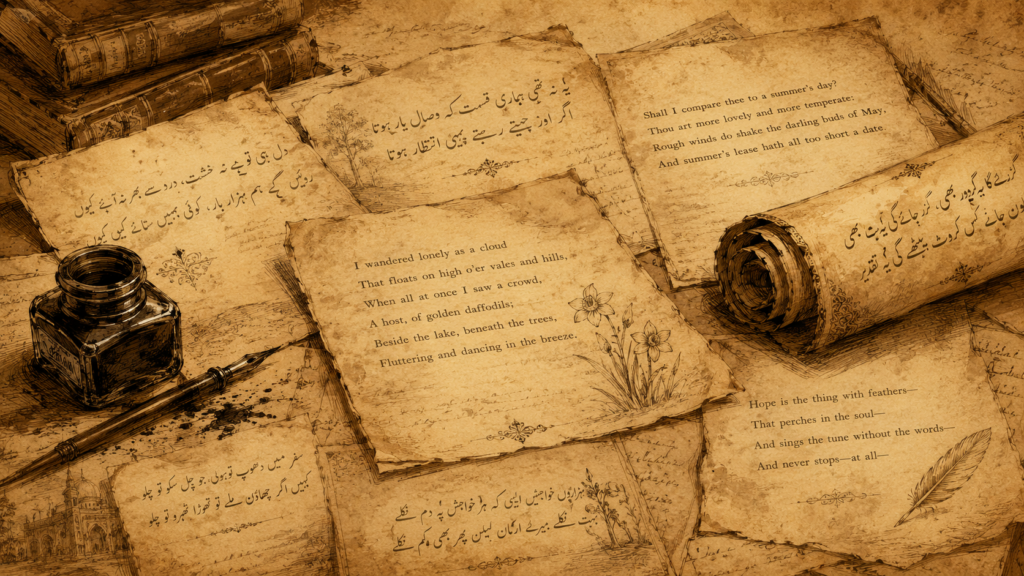
One of the many things that I inherited from my father was his love for poetry, specifically Urdu Ghazals. Poetry appears in many forms: poems, ghazals, nazms, sonnets, odes, elegies, ballads, free verse, etc. Personally, I love anything that rhymes.
Poetry is quite powerful as well, if you get the hang of it. When I am able to connect with the seemingly un-seeming words of a poem, I am hooked. It feels like magic as it makes me start looking at the world in a different light. No wonder Poets were both chastised and cherished by powerful governments right through history, just because poems have the ability to stir the masses. Our own Allama Iqbal is rightly credited with instilling a sense of unity and belonging in our struggle to form a country for the Muslims of the subcontinent.
The beauty of poetry, whatever language it may be in, is that its real meaning is often hidden behind layers, which one has to peel back to reach the heart of it.
So over time, I developed a simple method to understand poetry.
1. Read the poem. ‘Duh. That’s so original!’ you might say. But the reason I mention this is that you might get frustrated because the words are too difficult, OR you don’t understand the meaning or context. Don’t worry, that is normal. Just keep reading and finish the poem in one go.
2. Highlight the difficult words and find their meanings. In the age of AI, you can find the meanings very quickly. I normally take a picture and put it in Gemini and ask it to give me the meanings of the difficult words. I do still highlight those words and write their meanings inside the book. It saves me going back and forth between the book and Gemini during my multiple re-reads.
Read the poem again. At this point, the first layer should be removed, and the literal meaning would be surfacing.
3. Find the hidden meanings. This is where the magic lies, and it requires a little bit of effort. I call this as ‘finding the meaning of the meaning’ or what the poet actually means. This step is important and would need a little bit of research on the poet and his worldview.
Because great poets do not write about just anything. They write about things that matter the most to them. Things that make them emotional. So to peel this layer and get to the hidden meaning you would have to find answers to some questions about the poet like ‘the times the poet lived in’, ‘what were some issues that society was facing at that time’, ‘what were some issues that the poet was going through’, ‘what did the poet normally write about?’, ‘what was his world view’, ‘what images or styles did he normally uses’.
Again, Gemini is a great time saver here. And normally, you would have to do this once for one poet. Because things that matter to great poets normally do not change in their lifetimes. Also, a poet hardly changes his style, e.g., a poet may use nature to explain his take on life. ,
Note that you might not agree with the poet’s worldview, but it is still important for you to understand where he is coming from.
These three steps are most important, and let us study them with an example.
e.g.
The Woods are lovely, dark, and deep But I have promises to keep And miles to go before I sleep And miles to go before I sleep
Here, the literal meaning can be that the poet likes the woods and likes to watch them. But he has some other work and wants to do that.
But this literal meaning is not very magical. Is it? So we have to ask some questions about the poet. Robert Frost loves nature. His poems, at least the ones I have read and loved, are all about nature. But he also relates them to life and choices in life.
So if you understand Frost’s style, you might peel the next layer and see that by ‘woods’ he means the ‘world with all its attractions’, and by ‘promises’ he means ‘responsibilities’ and by ‘sleep’ he means ‘death’. So the meaning of the meaning becomes that although he loves many things that the world has to offer, he has many responsibilities that he needs to fulfil and cannot ignore. And these responsibilities are so many that he denotes them by ‘miles’. And perhaps it would take a lifetime to fulfill them. But maybe somewhere along the way, he would find some other attractions like this and would just pause for a while to enjoy them, and then he would move again.
This is what I mean about finding the meaning of the meaning.
If you want, you can stop here. But I have a few more steps.
4. Find your meaning. You don’t need to go with what the poet probably meant by his poem. Poems, Ghazals, and Nazms are so full of options that you can draw your own meaning. For example, in the lines above, I like to draw a meaning that connects with my own being and its relationship with my Creator — the magnificent Allah Almighty — and with the attractions that Allah Himself has placed in this world for us.
If I use these attractions to pause for a while, enjoy them, and re-energize myself, then they are helpful. But if I allow them to make me forget my responsibilities and the purpose of my life, then I am at a loss.
5. Listen to a good orator so that you can know how to recite the words with correct pronunciation and weight. I love doing that. Because it helps me read with emotions.
6. Finally, read it many times and also explain it to others. Often, I explain a new Ghazal or poem that I have decoded to my kids or my wife. Sometimes the expression on their faces, when they get to know the actual meaning, is priceless. Many times, they explain the meanings that they understood to me, which I love even more. Most importantly, this helps me memorize the poem.
Well, that is it for today. I will leave you with a poem by Robert Frost, and you let me know in the comments your meaning!
Nature’s first green is gold Her hardest hue to hold Her early leaf’s a flower But only so an hour Then leaf subsides to leaf So Eden Sank to Grief So dawn turns down to day Nothing Gold, can stay.
I am totally hooked on the Avocado Shake in Aseer Time. It’s not very sweet, and each sip brings it with many flavors. The best part is the fresh dry fruits. Try it with caution. You might be hooked.
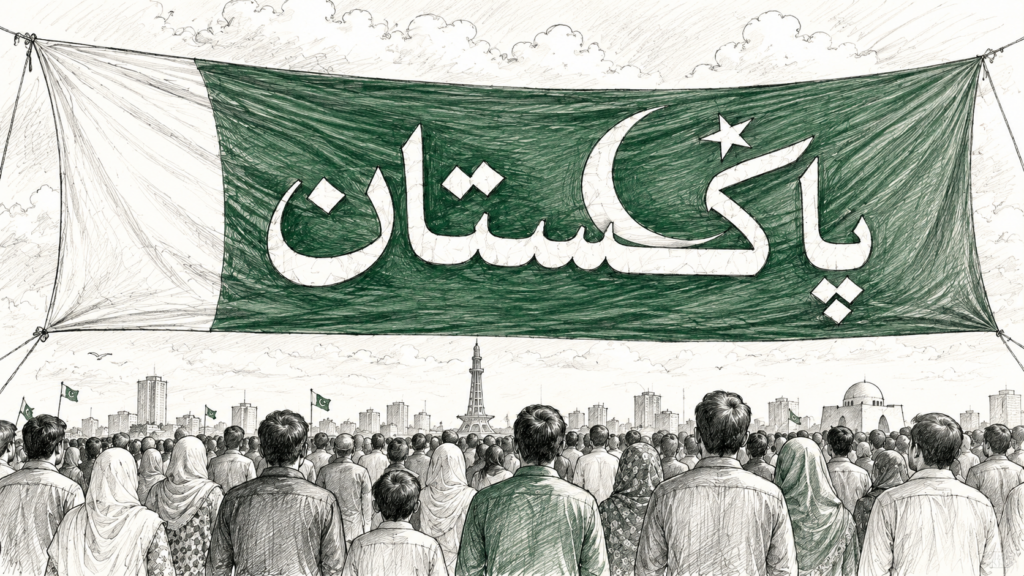
In his extremely informative book 1971 — Fact & Fiction, Afrasiab Mehdi Hashmi writes that Pakistan’s soul is bigger than its size.
This sentence made so much sense to me that I had to stop reading for a while and think about what I had just read. Pakistan’s soul is bigger than its size. Which meant that the idea behind Pakistan is larger than the land it occupies. As Pakistan was not created as a separate homeland for people belonging to a specific race, language, colour, tribe, or ethnicity, but rather for people, the Muslims, who wanted to live their lives as per the Quran and Sunnah.
I do not know whether our founding fathers fully grasped the depth of the idea of Pakistan that they were striving for. Maybe they just wanted freedom to practice their religious customs and rituals without fear of discrimination from an antagonistic Hindu majority. Maybe some, like Quaid-e-Azam Muhammad Ali Jinnah, had something broader in their mind, like an Islamic system of finance and governance. Or maybe even some were motivated by the greed of earning power, money, and position.
Maybe our founding fathers imagined and planned for it, or maybe they did not. But this is what we have today. A Pakistan that unites distinct nations — Punjabis, Sindhis, Pashtuns, Baloch, Muhajirs and others — by their belief in Allah and His final Messenger ﷺ.
Suddenly, we are in a position to not just freely practice our beliefs but also show the world the beauty of an Islamic way of life. How complete it is. How successful it can be. How Islamic values can organize society, economy, education, justice, family, politics, and morality. Pakistanis are now tasked to show how an Islamic system can protect the poor through Zakat and Ushr, and how minorities and non-Muslims can be protected with justice and dignity. How taxation can be fair and limited. How governance can be moral. How wealth can circulate. How power can be restrained. How can the law be above the powerful.
The more I think about it, the more I see it as a huge responsibility that has been placed upon us. History has seen much bigger Islamic empires such as the Banu Umayya, Banu Abbas, and the Ottomans with the same responsibility. They, too, held within their boundaries people who belonged to different races but were united by their belief in Allah and His final Messenger ﷺ.
But now, history has passed this baton to a much smaller and much less powerful country – Pakistan.
Additionally, this modern world has brought with it many new complex and intricate systems, like banking and finance, media and propaganda, mass education, modern armies, international law, technology, and nation-state politics. All of which has to be studied and structured in accordance with Islamic rules.
And in 78 years of our existence, how well have we done towards fulfilling this responsibility? Despite some pessimistic judgements, I do not see complete darkness. We have worked towards Islamic banking and Modern Islamic education systems. We have a professional armed force where soldiers can easily inculcate the glorious Islamic principles of Jihad and Shahadat. We have scientists, scholars, teachers, writers, businessmen, students, and ordinary people who can still dream the Islamic dream and execute it within their individual and social capacities.
Also, as we move towards 100 years of our existence, we must protect ourselves from forces that can take us away from the Quran & Sunnah. We must protect ourselves from our own laziness and lethargy. We must protect ourselves from corruption, nepotism, dishonesty, and the love of shortcuts. We must stop treating Pakistan merely as a piece of land from which we extract materialistic benefits.
We must raise our children with modern education, yes, but also with strong tarbiyyah. They must learn mathematics, science, finance, technology, and languages. But they must also learn what is right and wrong. They must know who they are. They must know why Pakistan was created. And how to defend that dream.
This divine purpose of Pakistan cannot be protected merely by slogans, flags, songs, or speeches. It has to be protected by living it every day. In our homes. In our schools. In our offices. In our businesses. In our politics. In our courts. And most of all in our characters and in our hearts.
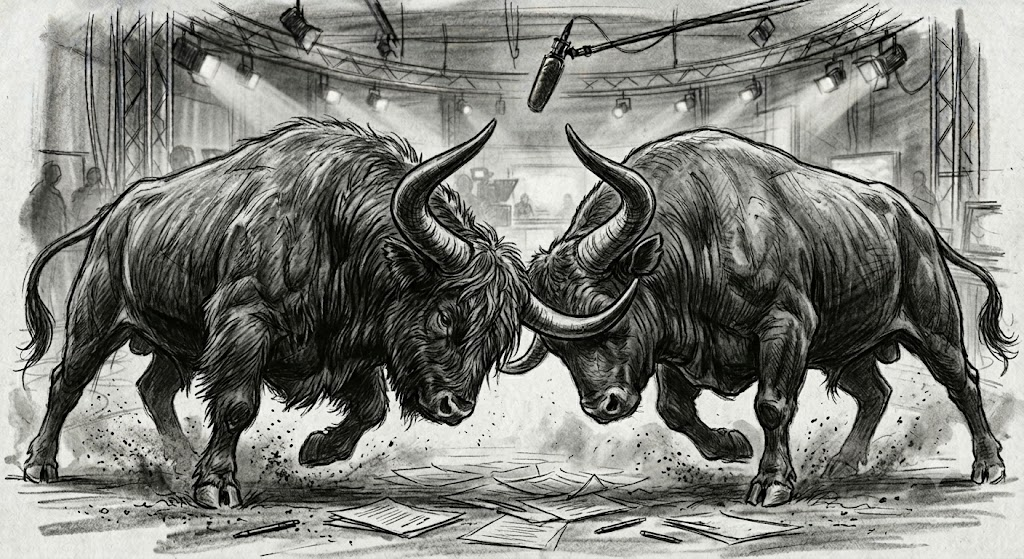
His eyes were bulging out of their sockets. He had a very sullen, sombre expression on his face, which had turned red, possibly because of the underlying pulsating arteries about to burst. He sat on the edge of the seat with his arms on the table right opposite his opponent. It looked as if they were dueling rather than debating.
He was not letting his opponent explain his point of view. He would cut his opponent’s sentence, quickly pass a judgement, which basically meant how stupid his opponent was (and as a reflection of how bright he was). His carefully selected audience immediately clapped, and his paid staff immediately turned this long debate into a short clip for YouTube and Instagram, after which his copywriters came up with a clickbait title that basically said he had destroyed his opponent. And then, with the help of bots and fellow sympathizers, they made the video viral.
When I saw this short clip, although I agreed with his point of view more than his opponent, I immediately felt that this was exactly how not to win an argument.
For me, there is a difference between winning an argument and settling an argument. You might win an argument with theatrics and a carefully planted audience. But settling an argument basically destroys the opponent’s defense bit by bit, so much so that the opponent himself feels that he has lost, and next time he either should change the topic OR change his line of argument.
I have seen much more intense debates on topics which were much more sensitive, but carried out with a calm and peaceful demeanour. e.g., Rather than burning the books of the Bāṭinī sect, Imam Ghazali (ra) chose to burn the arguments inside their books. A burnt book can always be written again, but an argument that has been properly exposed, answered, and defeated cannot rise again with the same strength.
I feel we should try to settle arguments and not just win them. The best way to do that is to try to understand the line that your opponent is taking to such a deeper level that you can explain your opponent’s argument more lucidly than the opponent himself. Listen to him in a calm and composed manner. And don’t try to put words in his mouth.
And after he finishes, take his argument and defence apart, bit by bit. Make sure you cover all angles and reply to all his points. Sometimes your single sentence would destroy his entire line. This is how you can settle the argument and not just win it.
Obviously, this requires a bit more reading and preparation than a simple fist fight of words. Well, it’s just a thought. You tell me what you think. Till then
I had ordered an e-reader, which was supposed to be shipped from Abu Dhabi. Considering the current situation, I assumed it would take at least a week to reach Kuwait. Even the expected delivery date was showing 14th to 15th June.
But lo and behold, it arrived in two days.
I don’t know whether I was lucky and placed the order at just the right time or whether this is normal for them. Either way, I was pleasantly surprised.
I have been looking for my first e-reader for quite some time, but I was not able to find it in any of the electronics stores here in Kuwait. Recently, I read a positive review of Noon.com on 248am.com and thought I should give it a try.
I am glad I did.
I will definitely consider ordering from Noon.com again when the need arises. As for the e-reader, I will use it for a few days and then write something about the experience.
So you are telling me to “come out of my comfort zone,” to “explore life,” because “you only live once.”
But my question to you is: why?
If I am fulfilling my responsibilities, then let me enjoy the comfort of my comfort zone. Let me relax, recharge, and basically be comfortable.
Don’t tell me that you wake up at 3 a.m., pick up heavy boulders, swim in a freezing river or lake, kill a bear with your bare hands for breakfast, and then you do this and then you do that, and then finally, at night, you sleep out in the open with hard rock as your bed, leaves as your blanket, and the sky as your roof.
I don’t care if you sleep with the lions.
After my 9 to 5, I am happy to eat freshly prepared, tasty, home-cooked food, lie down on my bed, read a book, and sleep with my head on a comfortable pillow, under a blanket of just the ideal weight, with the room temperature set to just the right centigrades.
Thank you very much.
I, and millions like me, have spent a considerable amount of time and effort making our lives comfortable. So when you come and tell me to leave that comfortable life, then sorry, I would simply say that you are yapping.
Maybe one day, if I decide, after all my calculations, that I feel like taking some sort of risk, then I may leave my comfort zone, dip my toes into the freezing water, and see if I am interested or not. If not, I will wear my socks and shoes again and come back to my comfort zone.
But if I like it, then I will make plans to extend, not leave, my comfort zone to include whatever new thing I want to add to my life.
You might ask: what will happen if life throws me a curveball and I am pushed out of my comfort zone?
Well, that is a possibility.
But then why make my life uncomfortable today on the assumption that it might become hard tomorrow? Why not enjoy the wonders and beauties of life while I can?
And who knows whether my assumption about the curveball is even correct? Maybe I make my life uncomfortable to prepare for financial losses, but I get health losses instead.
I am truly sorry, but I am not interested in challenging my comfort zones, only to get stuck while climbing a mountain and die of hunger and thirst. Good luck to all the daredevils out there. But I am frankly not very interested in it.
Till then, I will enjoy the comforts that Allah has bestowed on me. Be thankful. Be gracious. And even ask for more.