How can I instill this in the hearts? My heart desires that everyone comes to the right path in such a way that the glory of Islam is manifested from their every action, just as people used to accept Islam by observing the respected Companions (Sahaba-e-Karaam); We should all adopt the Sahaba as our role models. The betterment of this world and the faith is hidden within this.
It is a factual matter that if Muslims reform themselves and religion becomes firmly rooted in them, then and only then can Islam be established. Whatever worldly calamities are swarming us nowadays, Insha’Allah (God willing), the situation will completely turn around in a few days. And although there can be intellectual arguments for this, I wish I could reveal the experiential (spiritual/inner) portion of it, but I do not have the power to express it.
Notes to myself
After listening to numerous lectures from Ulema-e-Karaam, my belief has been strengthened: I have to change myself and align my surroundings (my own personal being, my home, and my office) with the teachings of Islam rather than someone else to do it for me.
I realized that the answer to the question ‘When would Islam become a power again?’ is not that “they” (the people, the government, the army, the bureaucracy, etc.) have to change; the answer is that “I” have to change. This change will not come through bullets or force; it will only come when we change ourselves.
The Messenger of Allah ﷺ said Befriend your friend with moderation; it may be that he will become your enemy one day. And hate your enemy with moderation; it may be that he will become your friend one day
Although the disbelievers are inherently subject to abhorrence and hatred (towards Muslims), maintaining moderation is still required even in harboring animosity towards them. Similarly, maintaining moderation in both love and hatred is absolutely essential. The jurists (Fuqaha) have gone so far as to forbid the remembrance of Allah (Zikr) when it is done inappropriately or out of place; in fact, in certain contexts, they have deemed it an act of disbelief (Kufr), such as saying “Bismillah” (In the name of Allah) over unlawfully acquired (Haram) food. In short, everything has its own designated rights and prescribed boundaries.
Our brothers (Muslims) lack the disposition for obedience and following leadership (Ittiba). Even if their commitment to faith (Deen) is not perfect, they should at least possess the capacity to follow someone. This is precisely why they are ruined.
Another reason is that they completely lack internal discipline (Nazm) and adherence to principles. If they work on combining proper organization on one hand with faith on the other—then clearly the path to divine help will open.
In the era of the Companions, what numerical strength did the Muslims possess against the Byzantine and Persian Empires? Yet, they were people of faith (Deen) and were highly organized. If proper organization accompanies faith, then see what wonders unfold! Conversely, entangling oneself in a disorganized state is to cast oneself into destruction.
And Life is a trust from God; “Do not kill yourselves” (لا تَقْتُلُوا أَنْفُسَكُمْ – Surah An-Nisa, 4:29) Sacrificing one’s life for the sake of God is no small matter, but there must at least be the satisfaction and certainty that it is undeniably being spent for God’s sake alone.
To read all the blogs on the Malfoozat of Maulana Ashraf Ali Thanvi, click here
وَمَن يَتَّقِ اللَّهَ يَجْعَل لَّهُ مَخْرَجًا. Whoever fears Allah, He brings forth a way out for him – 65:2
Taqwa, as I understand it from what I have been able to gather and retain from the discourses of our honorable Ulema, manifests in both our hearts and our actions. To the best of my limited understanding, it is a state that prevents us from not only executing anything that displeases Allah but also contemplating it.
Taqwa is not a physical or paralyzing fear, but rather a fear born of deep reverence. It is the protective anxiety of risking the displeasure of the Almighty—much like an upright person who, out of pure love and respect, would never do anything to grieve their parents.
This, as the Aayat in the Malfooz mentions, is a key to getting out of any adverse situation and, in my experience, not being in one in the first place.
To read all the blogs on the Malfoozat of Maulana Ashraf Ali Thanvi, click here
When a questioner asked a question on behalf of the general public, stating that ‘People often ask/wonder about …’, Maulana Sahab advised that such inquiries should only come from the individual who genuinely intends to act upon them. Even if someone asks, simply tell them, ‘We do not know.’
This and similar Malfoozat, discourses, and lectures from Ulema-e-Karaam have drilled into my head to focus on things that I control and not to waste time even in discussing/arguing on things that have no relevance to strengthening my relationship with my creator, Almighty Allah
To read all the blogs on the Malfoozat of Maulana Ashraf Ali Thanvi, click here
Just as the ignorant among the Sufis claimed Sharia (divine law) and Tariqa (the spiritual path) to be two separate things, thereby escaping the binding commandments and forming a permanent sect—and now they see no need for Sharia—similarly, another group has claimed Sharia and politics to be separate from each other, thereby escaping the commandments, and this too has become a permanent sect.
To read all the blogs on the Malfoozat of Maulana Ashraf Ali Thanvi, click here
Inna al-hukmu illa lillah إِنِ الْحُكْمُ إِلَّا لِلَّهِ
It is hard to find a single English word for hukm. It can mean order, rule, decision, judgment, command, or authority. So perhaps one way to translate it is:
“The final rule and decision belong only to Allah.”
And then, as often happens while reflecting on the Quran, I started having a conversation with myself. I started piecing this Aayat together with some other unsolved equations in my brain.
The Quran is like that. You can go as deep as you want, and the deeper you go, the clearer the picture becomes. I do not know how deep I have reached. Maybe I am still in shallow waters. But these questions are my attempt to understand these words of the Quran a little more.
Does this Aayat mean that all political struggle is a waste? That rulers and heads of state, whom we consider the most powerful people in the world, are actually not powerful at all? In many other places in the Quran, Allah says that He gives mulk — power, kingdom, authority — to whom He wills. So should we blame rulers for our state of affairs? Or is there another question before that? When we are not doing our duty to Allah, can we expect rulers to do their duty towards us?
When we are not obedient to Allah, why do we expect others to be just, obedient, merciful, and responsible towards us?
Am I waiting for society to change, while society is waiting for me to change? Is there a link? Will society change when I change? Or at least, will my part of society change when I change?
Maybe this is why many of the learned scholars stayed away from positions of power. Even when power was offered to them, they refused it. They chose instead to focus on learning, teaching, reforming hearts, and preserving the principles of Islam. Perhaps they understood something that we keep forgetting: power is not always where we think it is.
إِنِ الْحُكْمُ إِلَّا لِلَّهِ
And maybe this is also why so many “impactful” leaders — those whom we call great, cruel, wise, foolish, successful, or disastrous — often set out to do one thing and end up doing something entirely different.
They planned. Others reacted in ways that they didn’t expect. And history moved forward.
But finally, whatever happened was whatever Allah commanded to happen.
I read this book, Assaan Naikiyyan, by Mufti Taqi Usmani, many years ago and found it very helpful. So I included its reading in our daily Taleem after Isha.
The premise of the book, as the title suggests, is how to do deeds that carry the highest reward with the minimum effort. Till now, we have read three easy good deeds.
Intention. For any action that we do during the day, we should make the intention that this action is purely for the Raza of Allah. Even for work that is purely for our duniya, like going to the office, going to the gym, or going out to dinner with family or friends, as long as it is not a haraam activity, we can make the same intention. It does not take much time, but it converts the entire action into a form of worship and therefore becomes a means of earning a great reward.
Dua. Ask Allah. Speak to Allah. Before any action or after any action. When you succeed or when you fail. When you are scared or when you are confident. When you are happy or when you are sad. Ask for His Help. Tell Him what is going on in your life. What is good and what is bad? What you liked and what you did not like.
Often, Ulema explain dua not only as “asking Allah” but also as “talking to Allah.” And Allah is the only One who encourages us to make duas and ask Him for everything and anything that we want. Even our Prophet ﷺ guided us to ask Allah for help even if the lace of our shoe is broken and needs to be mended.
Again, this does not need much preparation or any big effort, and the rewards are so many that they cannot be counted. The biggest reward that the book mentions is that dua builds a strong, unbreakable bond between Allah and us. Is that not the biggest reward one can hope for?
You only need to remember to do it. And the more often you do it, the more natural it becomes.
Masnoon Duaein. These are the duas, or invocations, that our Prophet ﷺ used to recite before starting his daily activities. For example, waking up, going to sleep, entering the washroom, coming out of the washroom, eating, drinking water, looking in the mirror, wearing clothes, leaving the house, returning home, entering the masjid, leaving the masjid, starting a journey, etc.
There are many books available that contain these duas. If we can memorize even one dua per day, then within a few days, all our daily work will start with the blessing of Allah, because it will begin with the prayer that our Prophet ﷺ taught us. And hence, the rewards would be much higher, while the effort would not even total more than five minutes per day.
Well, that is where I have reached in the book so far. As I read more, I will add more.
The four noble traits that made Hazrat Jafar Tayyar ؒ beloved to Allah, even before the advent of Islam (during the age of Jahiliyyah).
Avoidance of Alcohol. He says that he never went near alcohol because he saw that alcohol destroys intellect.
Avoidance of Idolatry. He says that he avoided idol worship because he saw that idols could neither provide benefit nor harm.
Avoidance of Adultery. He says that because he possessed a strong sense of honor regarding his wife and his daughters, he never committed adultery.
Avoidance of Lying. He says that he never lied because he regarded lying as an act beneath the person of a high character and an act lacking any moral worth.
The importance of the traits, besides being beloved to Allah, can be assessed from the fact that they were specially revealed by Allah on Prophet Muhammad ﷺ through Hazrat Jibrael ؑ
In my journey through life, I’ve realized that character isn’t built all at once; it’s assembled piece by piece from the virtues we choose to honor. I blog about these traits to ‘collect’ them and try to integrate them into my own life and identity. For me, Hazrat Jafar Tayyar’s ؒ story is a reminder that true integrity begins long before the world notices.
Khushu and Khuzu are the essential states during Salah/Namaz. Some scholars have even called it obligatory. However, the most common view that most scholars have taken is that the benefits of Salah will start if it is offered with Khushu and Khuzu.
Khushu means to be in a state where your heart and mind are empty of all thoughts and you are fully focused on what you are reading in Salah. And Khuzu is a state in which the body stays still and avoids any type of extra motion e.g. scratching, yawning, flinching, or moving needlessly.
A Salah offered with Khushu and Khuzu has many benefits. The benefits can be felt more than they can be explained.
Khushu and Khuzu can be obtained in many different ways. Khuzu, the stillness of the body can be easily achieved by trying and making an effort.
Khushu, however, requires more inner work. Khushu that is the emptying of mind and heart from all thoughts, can be achieved by
Moving your mind from the thoughts that are generated in your mind to the words that you or the Imam are reciting.
Memorizing new Surahs or portions of Surahs with meaning and reciting them during Salah.
Telling yourself that Allah is much bigger than the thoughts being generated in your mind.
Imagine that you are meeting Allah or that one day you will meet Allah.
Salah is the connection between us and Allah and the stronger that connection is, the more beneficial it would be for us. If we want to realize The Pakistan Dream we need to make an effort to offer Daily Salah with Khushu and Khuzu.
Political debates are pretty common in our country. Usually, they’re about “who is better for Pakistan.” Rarely do they focus on “what is better for Pakistan.” If we look at the manifestos of all political parties, military rulers, and even caretakers, we’ll find a few common themes: education, poverty alleviation, increasing exports, stronger defense, more jobs, and fighting corruption. But if we dig deeper into their hidden agendas, it all comes down to one question: “How do I come into power and how do I stay in power forever?”
My point is that none of these published or unpublished manifestos, really serve Pakistan because they fail to answer one crucial question: “Who has given us the right to rule?” This question matters because we are accountable to whoever gave us that right.
In the Quran, Allah says: …Allah gives His kingship to whom He wills. (2:247)
This means that Allah gives us the right to rule, making the rulers accountable to Allah and Allah alone. Not to the establishment or judiciary. Not to the various mafias in real estate, agriculture, retail, or sugar. Not to the various superpowers or ‘brotherly’ Arab countries. Not even to the people of Pakistan. The rulers are accountable to Allah and Allah alone. And the reason that the right to rule is given by Allah, is to implement the laws that He has mentioned in the the Quran and Sunnah.
This important factor is not just ignored by our ruling elite but also by us. We too have been given a right to rule—a right to rule over our families, homes, and employees. And most importantly, a right to rule our own lives. We too are required to implement the laws of Allah in the domains that are given under our control.
The real change will come in our lives and our country when we accept this one important fact: Our lives, our children, our money, our fame, our rules, are all given by Allah and Allah alone. And they have been given to us for a reason, which is to implement the dos and don’ts as specified by Allah in the domains that we rule over. Have we done so? And if not, what right do we have to criticize someone who has not implemented them? What right do we have to criticize the rulers of our country? In Pakistan, implementing the laws of Islam is not difficult. In fact, they are quite easy and facilitative. If we still have not implemented these laws or agreed to implement them, then as far as I am concerned, we have no right to criticize anyone else, be it our neighbors, friends, or even our political elite. Everyone is busy disobeying Allah, and we are Everyone.
Whenever you embark on a journey, the unfamiliar surroundings and challenges can serve as profound teachers. The lessons learned in such moments are often etched into your memory, as they come amidst the backdrop of perseverance and a tested spirit. In a foreign land where roads and pathways are unfamiliar, and your mind and body may feel defeated, it is your soul that propels you forward. Nature, in these moments, imparts lessons that penetrate not just your body and mind but directly enter into your soul, leaving lasting imprints.
During my trip to Abha last year, I encountered a valuable lesson that shed light on a hadith I had heard many times before but now understood on a deeper level.
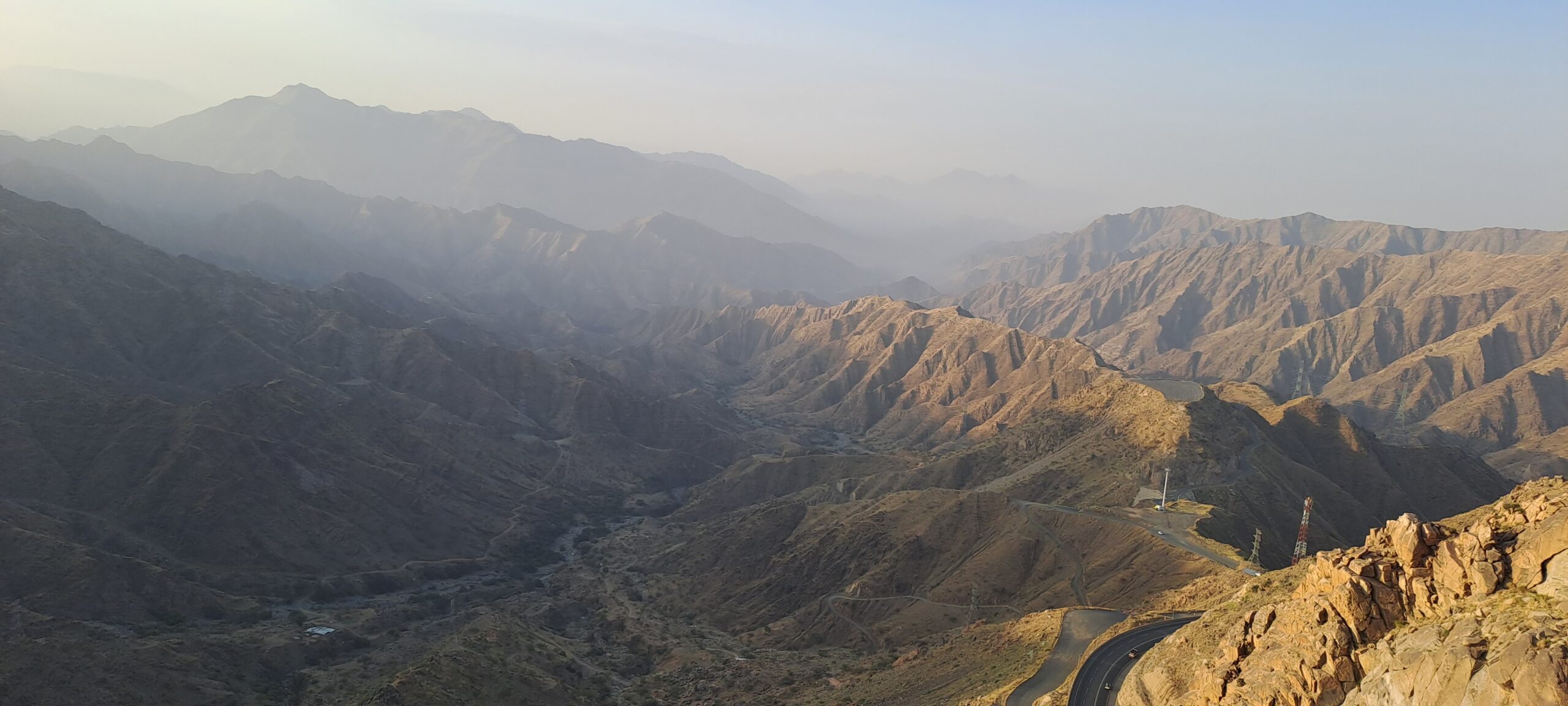
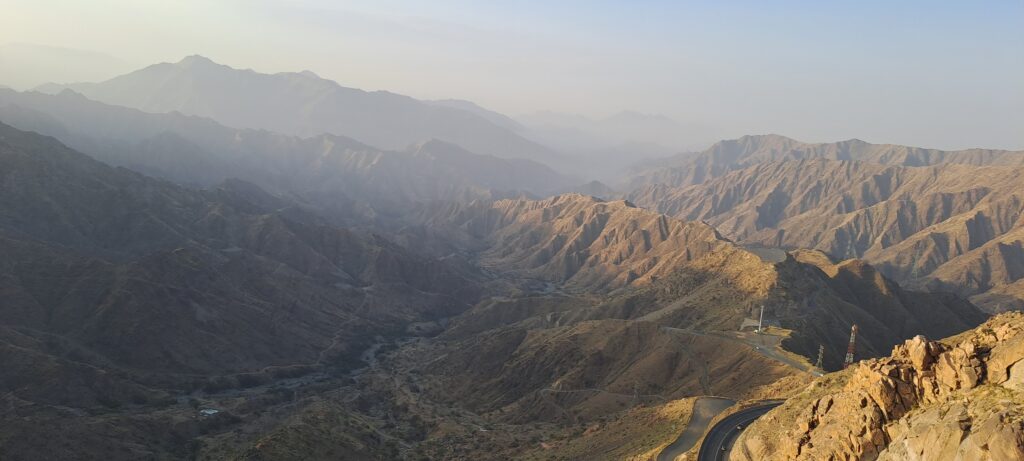
On a crisp morning, my wife and I ventured onto the Al Dahab walkway. The view was stunning. The mountains that surrounded us were a spectacle, with layers resembling the folds of a fully opened curtain, gracefully curved. Stretching as far as the eye could see, these majestic mountains framed the landscape. Between them, roads snaked through the terrain, accentuating the awe-inspiring beauty of the scene. However, what truly captivated me was the deep valleys nestled between the mountains. These valleys were so profound that the cars traversing the roads below appeared minuscule, resembling tiny mice scurrying through the vastness.
It was at that time that the hadith on greed raced into my mind.
“If the children of Adam possess a valley of gold, (still), he would wish that he has two valleys. And his mouth would never be filled except with sand. And whosoever makes Taubah to Allah azza wa jall, his Taubah would be accepted.”
(Bukhari; Muslim Shareef)
Standing on the sidelines, I imagined the valley in front of me, filled with gold, but not being enough. I thought about my yearning for just a ‘little’ bit more so that I may fulfill some more of my desires. I thought about millionaires aspiring to be billionaires and billionaires wanting more. Nothing, it seems, is ever enough for us. This thought made me realize that this perpetual desire for accumulation could be a profound spiritual ailment. At that moment, I made a heartfelt dua to Allah, pleading,
‘Ya Allah, protect me from such an illness, for I do not know how to protect myself’.
Standing there I started counting what I had and thanking Allah for each blessing. I started comparing my luxurious life with people with far less and still being happy and thankful for what they had. I started to think about how all of these blessings are not because of my effort but only because of the profound blessings of Allah.
Lessons from nature have a unique way of penetrating the soul, leaving us with insights that linger long after the journey has ended. This encounter, at least for me, served as a reminder to appreciate the blessings we have and to guard against the insatiable desire for more.
Imagine you are on a train, but you don’t know where it’s going. You don’t know why you are on it, or what you’re supposed to do when the train stops. You are sitting there, watching the scenery pass by, wondering what’s next. That’s what it feels like to live a life without purpose.
You might be traveling on a luxury train and have pleasant company and great food. Even the scenes might be breathtaking. But every few minutes you would be reminded of the fact that you don’t know why you are on the train. Who put you on it, where are you headed, and what you are going to do when the train stops? These questions would constantly bother you and beg you to answer them, no matter how luxurious your ride is.
Now imagine, you have the answer to all these questions, but the train ride is not very comfortable. The AC is not working, the food is not good, and unpleasant people surround you. But deep inside you would have peace because you know that the train would eventually stop bringing you to a destination of your choosing.
In the first instance, even with all the comforts you would feel uneasy, while in the second case with all the hardships you will have warmth and comfort in your heart, and you would be at peace. That is why it is so important to find the answer to the question of the purpose of our life; why we are alive?
Man’s Pursuit for Answers
This is the reason why man has always tried to answer the question; who gave us life and why? In their pursuit, different men took different paths. Some tried to create the answers and ended up creating man-made religions and philosophies that had varying degrees of popularity and acceptance. But such philosophies, religions, or ways of life, had a severe disadvantage. They were restricted by the capacity of the human mind and intellect. As a result, they were easily challenged, modified, or rejected by humans with a higher intellect or information.
The other path was to find rather than create the answers. This path started with the understanding that ‘someone’ put us on this earth and gave us life for a purpose. That the thing we call ‘nature’ is also a creation just like us. Created to ensure life. These people found answers to their questions in ‘Abrahamic Religions’ like Islam, Christianity, and Judaism. All of these religions provide not abstract but concrete answers to these questions i.e. ‘Life has been given by God’ for ‘Gaining HIS proximity and acceptance’. Humans do not create these answers but rather are told by God HIMSELF through HIS Prophets (messengers) and Holy Books.
How Islam Defines the Purpose of Life
Islam has not only given these answers in the Quran and Sunnah but has also taken many steps further. It has told us who God is and what are HIS traits. It has told us that the purpose of our creation is to ‘gain HIS proximity by worshipping HIM’. And the reason that HE created ‘life and death’ was to judge who performs the most noble deeds. Islam has also listed the acts of Worship and clearly defined how they are to be performed. It also classifies deeds into Good and Bad.
We are not left at the mercy of ‘Abstractions’ and ‘Interpretations’. What has been defined is to be followed. What has not been defined has been deemed not important to the ultimate purpose of life. So it can be interpreted in whatever way we see fit and fruitful.
Impact on my life
For me, knowing the answer to the question of the Purpose of Life through Islam is not only comforting but also keeps me focused. I understand why I worship Allah and recite the Quran. Why I got married and have children, why do I need to work and earn for my family, and also focus on the upbringing of my children? Why I need to be as productive as I can be and why I need to focus on my health and fitness. Why do I also need to go out and enjoy the various experiences that this world has to offer with my family and friends? The answer to all these questions is that Islam has categorized them as acts of ‘Worship’. And I need to perform them to gain proximity to Allah my creator.
Knowing these answers also insulates me from hardships and suffering. Islam tells me that hardships and suffering are also created to gain proximity to Allah. This journey of life on earth has to end one day. So it does not matter how luxurious or not the journey is. Eventually, when my life ends, based on how successful I have been in fulfilling the ultimate purpose, I shall enter a life full of luxuries that will never end. That life, the destination, is much more important.
Conclusion
The biggest question about life can be answered in a single sentence:
‘We are created by Allah, for HIS worship, so that our deeds become noble and worthy of acceptance by HIM, earning us HIS proximity and acceptance’.
The dreams we have at night may be random and fleeting, but the dreams we have while awake are the ones that matter most. They are the embodiment of our deepest aspirations and desires, and they are what make us human giving us a sense of purpose and driving us forward, even when things get tough.
Dreams can be noble or vile. Noble dreams chase equality and brotherhood bringing people together. Vile dreams chase money and fame driving people away from each other. Noble dreams cause the progress and development of humanity. Vile dreams cause their destruction through wars and famine.
For many people, the dream is to make money. But they fail to realize that beyond a certain amount, money would stop providing any additional value to the quality of their life. That is why making money should never be the sole objective of our lives, rather, it should be treated as a tool that would help us to realize loftier and bigger dreams.
Humans have been given a mind to think and a heart to feel. Using both together can help us craft bigger and nobler dreams.
Dreams and their impact
Noble dreams have the power to unite people. Consider Martin Luther King Jr.’s dream which positively impacted the lives of countless Americans and continues to do so.
“I have a dream that one day on the red hills of Georgia, the sons of former slaves and the sons of former slave owners will be able to sit down together at the table of brotherhood”
Martin Luther King Jr.
His dream centered on equality and brotherhood and not money or fame.
In our own history, Allama Iqbal presented a vision for the Muslims of the subcontinent.
I would like to see the Punjab, Northwest Frontier Province, Sind, and Baluchistan amalgamated into a single state. Self-government within the British Empire or without the British Empire, the formation of a consolidated North-West Indian Muslim state appears to be the final destiny of the Muslims, at least of North-West India
Allama Muhammad Iqbal
This dream, too, was not driven by financial gain or fame but rather by the aspiration to grant Muslims in the subcontinent the freedom to practice their religion and way of life without fear of persecution and hatred.
Dreams as tools to fight adversities.
Bigger dreams often come with greater challenges and hardships, yet they also give greater strength. The struggles of the black community in America, and the millions of lives lost during the partition of the subcontinent tell us that while the adversities were high, so was the willingness to sacrifice. When these communities compared the hardships required for the potential future, the sacrifices needed seemed inconsequential.
Nelson Mandela was given life imprisonment in 1964. During his trial he said
“I have cherished the ideal of a democratic and free society in which all persons live together in harmony and with equal opportunities. It is an ideal which I hope to live for and to achieve. But if needs be, it is an ideal for which I am prepared to die.”
Nelson Mandela
Dreams and their everlasting impact
Martin Luther King Jr. was assassinated in 1968 and Allama Iqbal died in 1938, well before they could witness the realization of their dreams. Both these examples are proof that when one’s dream is driven by a purpose greater than personal wealth or fame, the dream stays alive long after their physical presence has departed.
Dreams give us a bigger purpose.
Dreams give purpose and meaning to our lives and stop us from being influenced by petty emotions.
Nelson Mandela’s remarkable journey serves as a clear example. After spending 27 years in prison, one might have anticipated a thirst for revenge upon his release. Yet he writes in his book ‘Long Walk to Freedom.’
“As I walked out the door toward the gate that would lead to my freedom, I knew if I didn’t leave my bitterness and hatred behind, I’d still be in prison.”
Mandela chose to forgive, recognizing that his dream of a democratic South Africa where everyone enjoyed equal rights transcended personal emotions of hatred or revenge. Four years later, South Africa witnessed its first multiracial elections, which wouldn’t have been possible if Mandela’s actions were driven by hatred or revenge.
Conclusion
We might not be Allama Iqbal or Nelson Mandela, but we too can envision a future that we want to see. Maybe our names would remain unknown, but deep inside we would be satisfied that we lived a life of greater significance and provided more than we took.
“We all dream while we sleep, it is about time that we have a dream that will not let us sleep.”
Dr. Abdul Bari
This blog borrows a lot from the lectures on Strategic Visions delivered by Mr. Suleiman Ahmar, which are freely available on YouTube.
Due to the easing of restrictions on Saudi Tourist visas, it was finally possible to undertake the journey of Umra from Kuwait using one’s own vehicle after a decade-long hiatus. We all were quite excited. Our family had grown from 4 to 6 and the older ones are teenagers now, making this their first adult Umra.
To ensure a safe and smooth driving experience, especially when you have a 14 year old car, adequate planning and preparation is very necessary. I began the planning around a month before.
Before The Journey
Applying for Saudi Tourist Visa. The entire visa application process is online and very simple and straight forward. After filling in the form and paying the fees, the visa is sent to your email address within 5 minutes. Impressive!
Per person the cost was around 35 KD, which is not very cheap and not very expensive. Considering you can enter Saudi Arabia multiple times during a year, I would say that the price is just about right. The only hitch in the process was the multiple payments that one has to make for a single visa application e.g. Medical Insurance, Processing fees, visa fees etc. In all, if I remember correctly around 3-5 payments have to be made for one application, so if you, like me, are applying for your entire family from the same credit card, then your credit card will get blocked. In which case, either call your banking service provider and have it unblocked or use a different card.
Car Servicing and Repairs (if needed) Since the entire journey was to be made in our car, therefore, I had my car serviced and checked from the main service center. I also took a second opinion and then undertook the necessary repairs. Since we were going in winters therefore I didn’t bother myself with AC checkup and repairs. A day before, I had the tires rechecked, since they have to bear the brunt of the journey 🙂
Read and revise the steps of performing Umra, the restrictions of Ahram etc. Umra, like all acts of worship (ibadah) must be performed according to specific requirements and steps. Neglecting any of them may render the entire effort void. Also, it is not something that one does regularly, therefore we gathered as a family and revised the steps and requirements, explaining the entire process to ourselves and our kids, with special emphasis on the mental and spiritual conditions (adaab) that must be maintained during the journey. While the older kids had to adorn the Ahram in the proper way, for the smaller kids we bought stitched Ahrams, so that they too, get feel and understanding of Umra.
Planning the Route Finalizing the route is also an important step and must be done before the start of the journey. Your hotel bookings, packing etc are all dependent on that. There are two main options that one can chose from, a brief detail is provided for each option below.
Madina First.
The first option is going to Madina first, which is nearer to Kuwait. Around 12 hours drive from our home in Kuwait to the hotel in Madina (with one hour of border time), provided you prescribe to the speed limits of the various highways. The time only caters for small breaks like fuel and prayers.
Makkah First This is a longer route that takes around 14-16 hours with 1 hour of border time. The stoppages would have to be minimum (only petrol and prayer breaks). In order to take this route one has to leave quite early in the morning i.e. around 2 AM, so that maximum trip is covered in day light. The last 2 hours of the trip is a fenced and properly highlighted highway, with a speed limit of 140. so driving at night shouldn’t be much of a problem.
During the Journey
We decided to go with the option # 2 i.e. Makkah first, therefore we left our home around 3 am. Passing the border proved quite cumbersome for us as it took us over 3 hours to get through. This was quite unusual as most of my friends passed through within 1 hour. Our delay was mainly due to some unexpected rush at the fingerprint counter and an unusually long line at the security checks.
Speed Cameras Quite early I noticed that there were many speed cameras installed at various points. The cameras are supposed to detect not only high speed but also seat belt and mobile phone usage. A few miles in, I decided to put my car in cruise control i.e. set the prescribed speed limit and enjoy the view instead of focusing on following the speed limit.
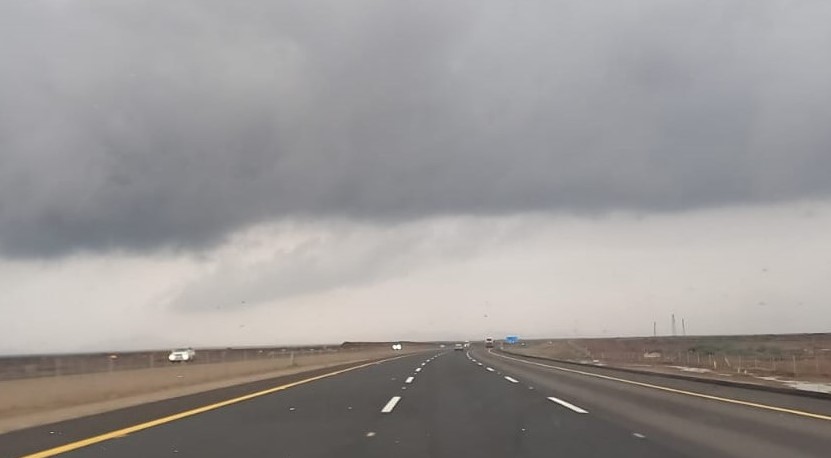
The Views! The weather was generally very nice and kept on changing throughout starting from foggy to raining to extremely windy towards the end. But, Alhamdolillah, the visibility stayed clear throughout. The nice weather plus the ever changing views made it a drive to remember. While everyone slept in the car, the calming silence allowed me to engross myself in the wonders of nature around me, so many I was able to see and capture, and so many I just drove by without noticing. The entire experience brought out the meaning of phrases like ‘Life is a journey’ marching in my brain.
Life Is a Journey!
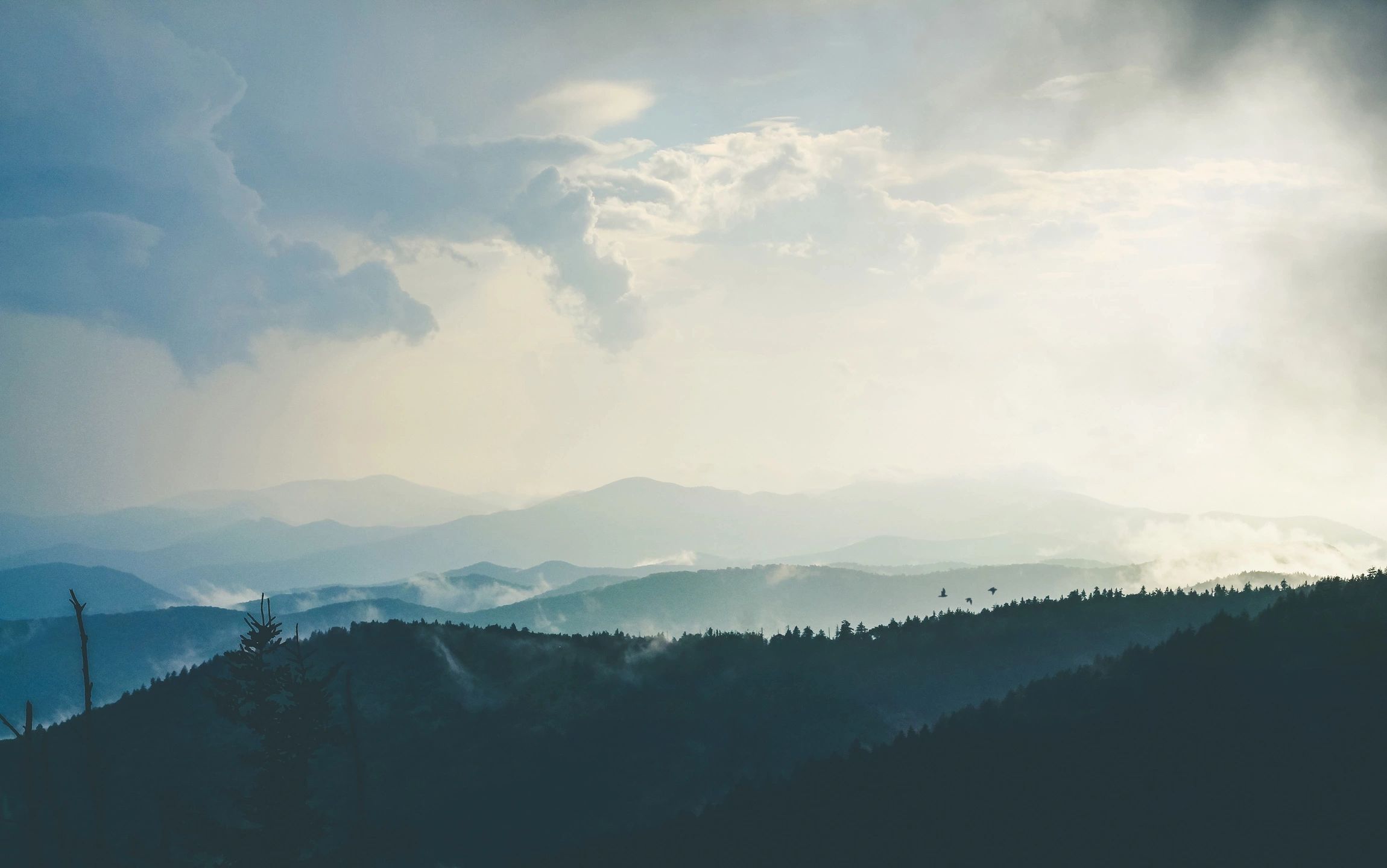
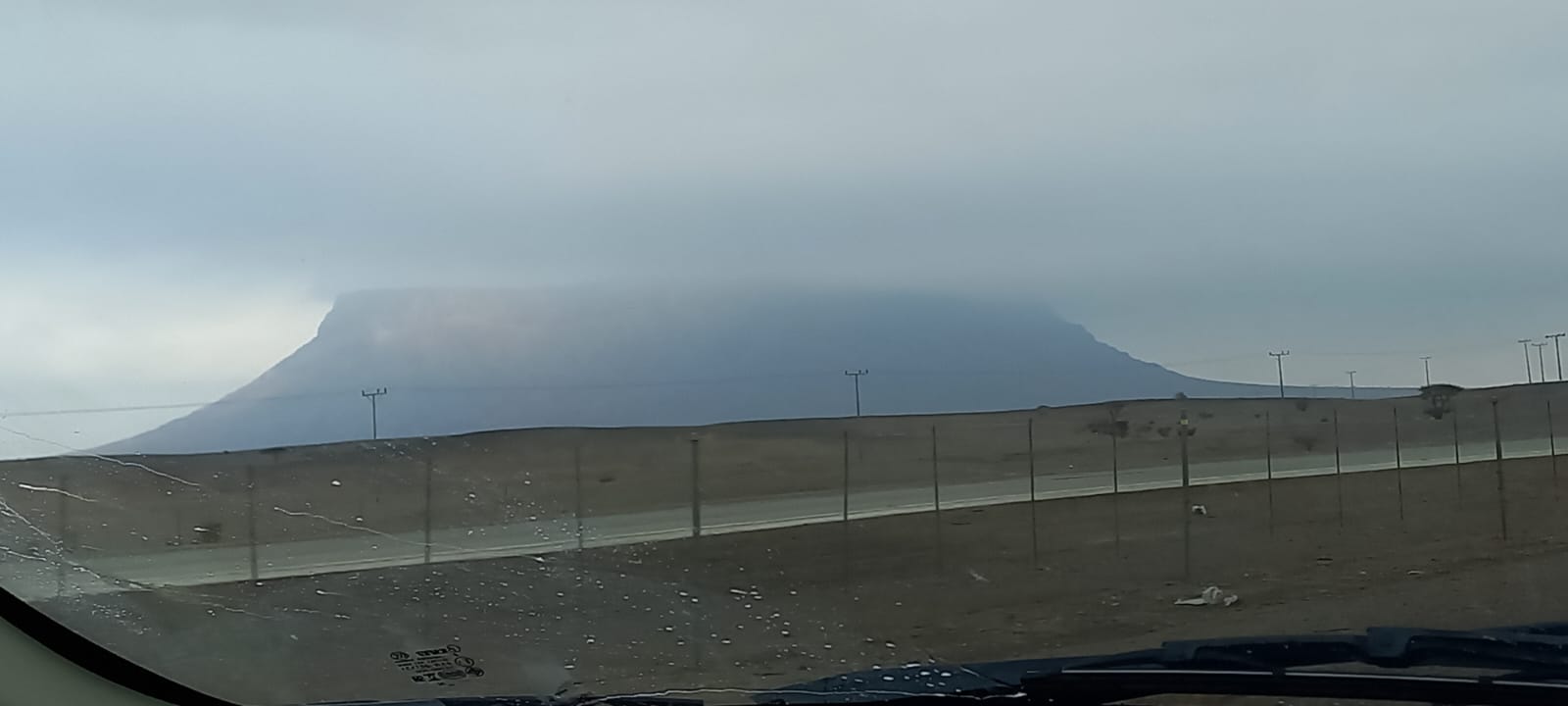
Driving through the vast and diverse lands of Allah allows us to see nature changing it’s colors, shapes and sizes. Some areas are fully and some partially developed, but the most serene were the areas that offered nothing but raw nature. Wonders, like a lone green tree standing in the middle of the desert, looking both peculiar and perfectly placed, or the silky and shining sands changing it’s colors every few hundred kilometers or the clouds coming down to play with a mountain. All felt like master strokes by the Master.
Clouds Covering A Mountain
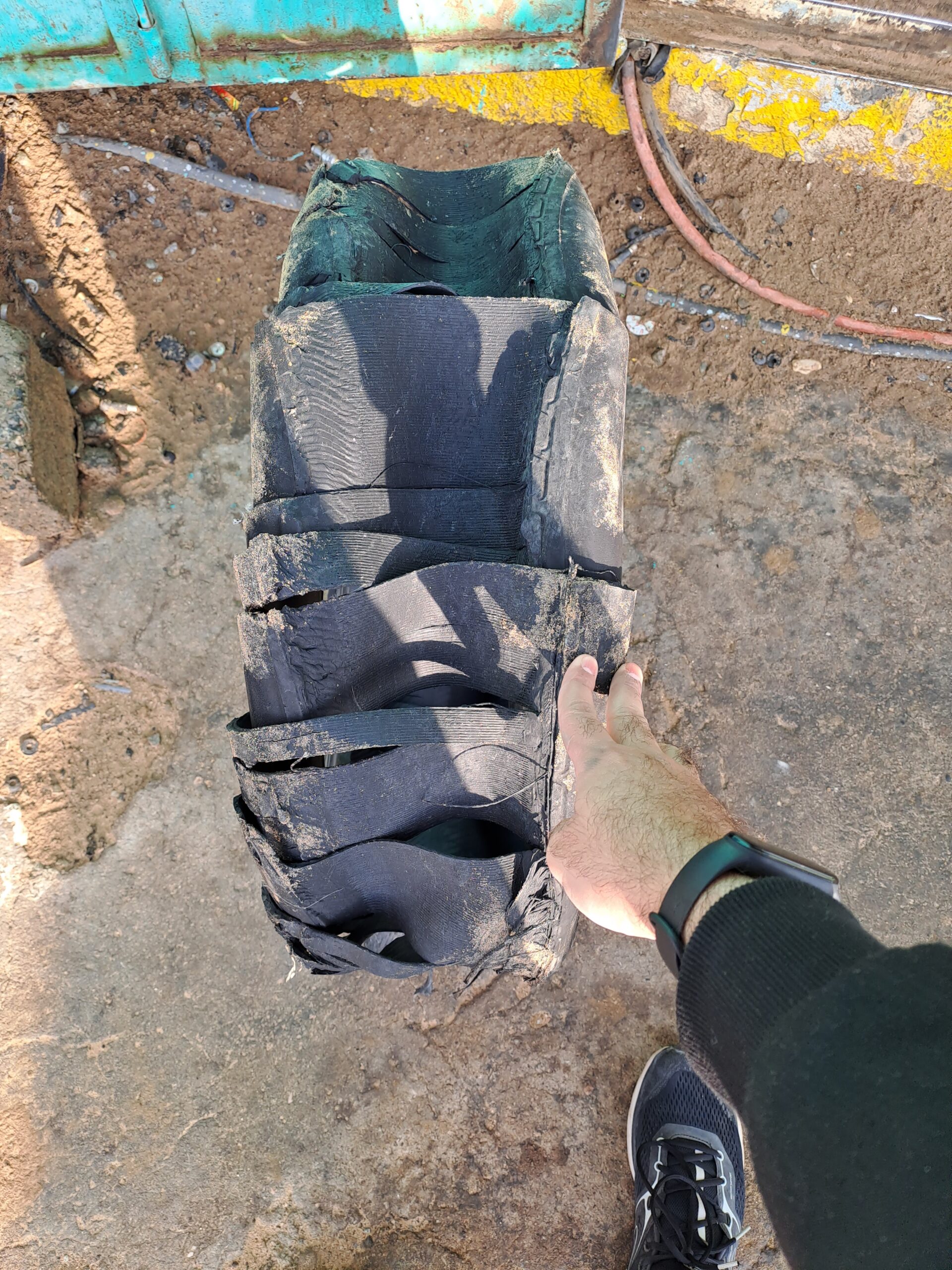
My Busted Tire
Safety The road conditions, throughout, were pretty good. I didn’t notice any kind of rash driving and the highways were properly patrolled. There were a lot of sign boards along the way highlighting the emergency call numbers. Towards the end of my journey my tire busted. Within a few minutes, while I wondered what to do and whom to call, a police patrol arrived and helped me in calling a maintenance truck. The maintenance truck arrived in around 20 minutes and did the needful. On a nearby shop I was able to find a new tire.
All the highways were in excellent condition, except for a small patch where we had to take a detour.
Pit Stops Although I noticed that many old petrol pumps were closed, maybe due a government initiative, but there were still plenty open ones available. Some of them quite cool, flashy and well maintained. I wondered what is the science or maths of building such petrol pumps, as I noticed some were pretty close to each other while the others a few hundred kilometers apart. Definitely a topic for a later blog.
The only thing I found wanting though, was the absence of mobile service providers. I had to practically stop in a few cities to search for an open mobile service provider as I needed to get a SIMM card. Although, due to it being a Friday, most of the shops were supposed to open after 4, but I found a few were closed even after 4.
The route also took us through various cities like Affif, Mujammah. So in case of any tiredness etc, a hotel can be taken in any of these cities. Due to some issues in the car, we made a stop in Dhulm, which is the last city before Taif. The price of the room was reasonable SAR 200 with excellent facilities for the price.
Before going into Makkah, we stopped in Sail Al Kabeer which is the Meeqat for people coming from Kuwait. We took a small room there for an hour and took a bath and adorned the Ahram. There are many shops selling Ahram and related stuff at a much cheaper price than Kuwait, so if one has a need then it can be fulfilled from there as well. After adorning the Ahram, we set off towards Makkah.
The Last Mile! With our car echoing with the sounds of Labayk and our hearts filled with anticipation, we headed towards the holy city of Makkah. The proverbial last mile was around 70 Kilometers and it is hard to describe it in words. We reached Makkah and after a few twists and turns were able to reach Kudai car parking. From there I moved towards our hotel and then eventually towards Masjid-e-Haram for performing Umra.
More about our experience inside Makkah in Part 2 of this blog. And then the trip to Madina and back to Kuwait.