وَمَن يَتَّقِ اللَّهَ يَجْعَل لَّهُ مَخْرَجًا. Whoever fears Allah, He brings forth a way out for him – 65:2
Taqwa, as I understand it from what I have been able to gather and retain from the discourses of our honorable Ulema, manifests in both our hearts and our actions. To the best of my limited understanding, it is a state that prevents us from not only executing anything that displeases Allah but also contemplating it.
Taqwa is not a physical or paralyzing fear, but rather a fear born of deep reverence. It is the protective anxiety of risking the displeasure of the Almighty—much like an upright person who, out of pure love and respect, would never do anything to grieve their parents.
This, as the Aayat in the Malfooz mentions, is a key to getting out of any adverse situation and, in my experience, not being in one in the first place.
To read all the blogs on the Malfoozat of Maulana Ashraf Ali Thanvi, click here
When a questioner asked a question on behalf of the general public, stating that ‘People often ask/wonder about …’, Maulana Sahab advised that such inquiries should only come from the individual who genuinely intends to act upon them. Even if someone asks, simply tell them, ‘We do not know.’
This and similar Malfoozat, discourses, and lectures from Ulema-e-Karaam have drilled into my head to focus on things that I control and not to waste time even in discussing/arguing on things that have no relevance to strengthening my relationship with my creator, Almighty Allah
To read all the blogs on the Malfoozat of Maulana Ashraf Ali Thanvi, click here
Just as the ignorant among the Sufis claimed Sharia (divine law) and Tariqa (the spiritual path) to be two separate things, thereby escaping the binding commandments and forming a permanent sect—and now they see no need for Sharia—similarly, another group has claimed Sharia and politics to be separate from each other, thereby escaping the commandments, and this too has become a permanent sect.
To read all the blogs on the Malfoozat of Maulana Ashraf Ali Thanvi, click here
One of my regular practices is to read the Malfoozat of Maulana Ashraf Ali Thanvi (رَحْمَةُ اللهِ عَلَيْه). Malfoozat, simply defined, are the casual or general words spoken by someone. They are not planned discourses (bayaans) or formal articles.
Reading them makes me feel as though I am sitting in the spiritual company of Maulana Sahab. His insights are full of wisdom, and the conversational style makes the advice deeply personal and practical to implement. I often find that just a few lines (malfooz) from Maulana Sahab are worth entire, well-researched books by Western authors.
I initially tried to expand upon or explain them, but I really see no reason to do so. Therefore, I will simply focus on translating the specific passages I have highlighted during my readings—the ones that have truly stuck with me over the years. InshaAllah I plan to post regularly.
I was reading some old book notes when I came across the notes written for Good to Great by Jim Collins, where he mentions the Stockdale Paradox.
During his time as a prisoner of war in Vietnam, Stockdale endured immense suffering and was held captive for over seven years. Collins interviewed Stockdale and discovered a fascinating contrast in the prisoners’ mindsets. While some captives maintained hope and believed they would be freed by a certain date, their optimism often led to disappointment and despair when those expectations were not met. On the other hand, Stockdale observed that those who survived the ordeal were the ones who faced the brutal facts of their situation head-on. They acknowledged the harsh realities of their captivity while still maintaining faith in their eventual liberation. This duality—confronting the brutal facts while maintaining unwavering faith—became known as the Stockdale Paradox.
I find this idea powerful, but I also think it can be an oversimplification in the study of human endurance.
My personal view is that it is very difficult to capture the real thought process of people who are passing through extreme adversity. No one principle or formula can be sufficient for every person, every wound, every tragedy, and every test.
When we look at Islamic history, we find many examples of extreme suffering faced by the Prophet Muhammad ﷺ and his noble companions. Their trials were not minor. They endured physical torture, mental pressure, family pressure, fear, hunger, poverty, social boycott, migration, loss of loved ones, and years of uncertainty. And yet what helped them endure was totally different, and I believe much more powerful, than the Stockdale paradox.
For someone unfamiliar with Islam, it may be tempting to fit these examples into the definition of the Stockdale Paradox: facing brutal facts while keeping faith in eventual success. But that, to me, stops us from going deeper into the real source of strength.
The first reason that I can think of that helped the Beloved Prophet Muhammad ﷺ and the Noble Companions endure was the realization that what they were fighting and suffering for was much bigger than their lives and the lives of their families.
The second reason was that their leader, the Noble Prophet ﷺ, was standing beside them and in almost all manners, suffering more pain than all of them. That may also be a vital lesson on leadership.
The third reason was that they knew if Allah has willed certain conditions on them, then He is their Master, and they accepted all decisions of their Master. They were guided by the Final Prophet Muhammad ﷺ to never ask for suffering, but once it comes, to be steadfast.
The fourth reason, which I keep coming back to, is Aakhira or the hereafter. That no one would be able to escape the day of judgement when the deeds of every person who was given life in the world will be evaluated. No one will be able to escape punishment. Even death would not be a savior for the never-ending punishment for those who have broken the commandments of Allah Almighty.
I do admire Jim Collins’ ability to research, study, and extract lessons from people and organizations, but I often wish that authors who spend years, sometimes decades, studying success, failure, resilience, leadership, and human behavior would also study the guidance given by Allah, the Creator of the universe and everything within it, on these topics. Because real solutions lie in the guidance of Allah.
May Allah grant us all wisdom, foresight, patience, and steadfast faith.
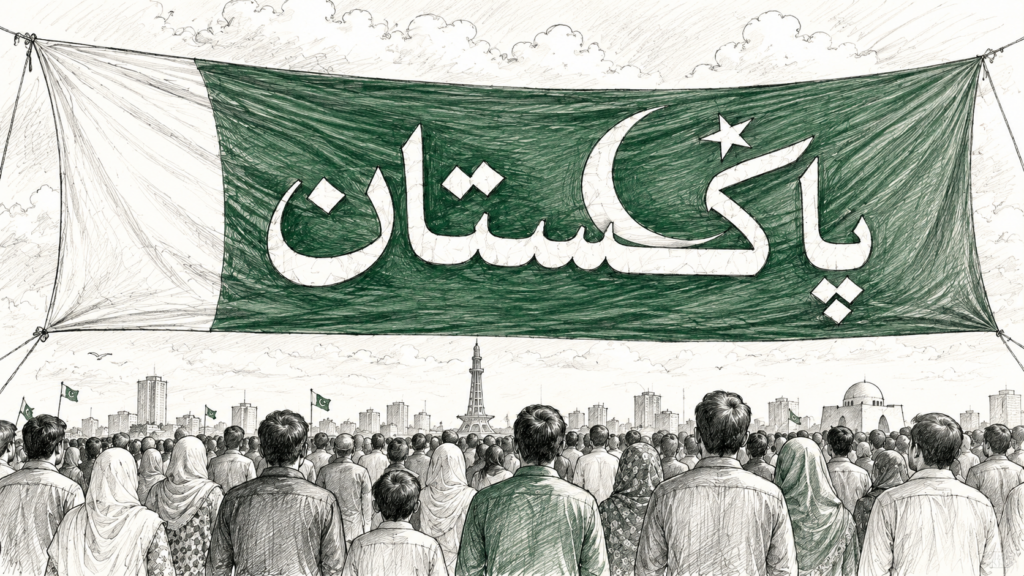
In his extremely informative book 1971 — Fact & Fiction, Afrasiab Mehdi Hashmi writes that Pakistan’s soul is bigger than its size.
This sentence made so much sense to me that I had to stop reading for a while and think about what I had just read. Pakistan’s soul is bigger than its size. Which meant that the idea behind Pakistan is larger than the land it occupies. As Pakistan was not created as a separate homeland for people belonging to a specific race, language, colour, tribe, or ethnicity, but rather for people, the Muslims, who wanted to live their lives as per the Quran and Sunnah.
I do not know whether our founding fathers fully grasped the depth of the idea of Pakistan that they were striving for. Maybe they just wanted freedom to practice their religious customs and rituals without fear of discrimination from an antagonistic Hindu majority. Maybe some, like Quaid-e-Azam Muhammad Ali Jinnah, had something broader in their mind, like an Islamic system of finance and governance. Or maybe even some were motivated by the greed of earning power, money, and position.
Maybe our founding fathers imagined and planned for it, or maybe they did not. But this is what we have today. A Pakistan that unites distinct nations — Punjabis, Sindhis, Pashtuns, Baloch, Muhajirs and others — by their belief in Allah and His final Messenger ﷺ.
Suddenly, we are in a position to not just freely practice our beliefs but also show the world the beauty of an Islamic way of life. How complete it is. How successful it can be. How Islamic values can organize society, economy, education, justice, family, politics, and morality. Pakistanis are now tasked to show how an Islamic system can protect the poor through Zakat and Ushr, and how minorities and non-Muslims can be protected with justice and dignity. How taxation can be fair and limited. How governance can be moral. How wealth can circulate. How power can be restrained. How can the law be above the powerful.
The more I think about it, the more I see it as a huge responsibility that has been placed upon us. History has seen much bigger Islamic empires such as the Banu Umayya, Banu Abbas, and the Ottomans with the same responsibility. They, too, held within their boundaries people who belonged to different races but were united by their belief in Allah and His final Messenger ﷺ.
But now, history has passed this baton to a much smaller and much less powerful country – Pakistan.
Additionally, this modern world has brought with it many new complex and intricate systems, like banking and finance, media and propaganda, mass education, modern armies, international law, technology, and nation-state politics. All of which has to be studied and structured in accordance with Islamic rules.
And in 78 years of our existence, how well have we done towards fulfilling this responsibility? Despite some pessimistic judgements, I do not see complete darkness. We have worked towards Islamic banking and Modern Islamic education systems. We have a professional armed force where soldiers can easily inculcate the glorious Islamic principles of Jihad and Shahadat. We have scientists, scholars, teachers, writers, businessmen, students, and ordinary people who can still dream the Islamic dream and execute it within their individual and social capacities.
Also, as we move towards 100 years of our existence, we must protect ourselves from forces that can take us away from the Quran & Sunnah. We must protect ourselves from our own laziness and lethargy. We must protect ourselves from corruption, nepotism, dishonesty, and the love of shortcuts. We must stop treating Pakistan merely as a piece of land from which we extract materialistic benefits.
We must raise our children with modern education, yes, but also with strong tarbiyyah. They must learn mathematics, science, finance, technology, and languages. But they must also learn what is right and wrong. They must know who they are. They must know why Pakistan was created. And how to defend that dream.
This divine purpose of Pakistan cannot be protected merely by slogans, flags, songs, or speeches. It has to be protected by living it every day. In our homes. In our schools. In our offices. In our businesses. In our politics. In our courts. And most of all in our characters and in our hearts.
I read this book, Assaan Naikiyyan, by Mufti Taqi Usmani, many years ago and found it very helpful. So I included its reading in our daily Taleem after Isha.
The premise of the book, as the title suggests, is how to do deeds that carry the highest reward with the minimum effort. Till now, we have read three easy good deeds.
Intention. For any action that we do during the day, we should make the intention that this action is purely for the Raza of Allah. Even for work that is purely for our duniya, like going to the office, going to the gym, or going out to dinner with family or friends, as long as it is not a haraam activity, we can make the same intention. It does not take much time, but it converts the entire action into a form of worship and therefore becomes a means of earning a great reward.
Dua. Ask Allah. Speak to Allah. Before any action or after any action. When you succeed or when you fail. When you are scared or when you are confident. When you are happy or when you are sad. Ask for His Help. Tell Him what is going on in your life. What is good and what is bad? What you liked and what you did not like.
Often, Ulema explain dua not only as “asking Allah” but also as “talking to Allah.” And Allah is the only One who encourages us to make duas and ask Him for everything and anything that we want. Even our Prophet ﷺ guided us to ask Allah for help even if the lace of our shoe is broken and needs to be mended.
Again, this does not need much preparation or any big effort, and the rewards are so many that they cannot be counted. The biggest reward that the book mentions is that dua builds a strong, unbreakable bond between Allah and us. Is that not the biggest reward one can hope for?
You only need to remember to do it. And the more often you do it, the more natural it becomes.
Masnoon Duaein. These are the duas, or invocations, that our Prophet ﷺ used to recite before starting his daily activities. For example, waking up, going to sleep, entering the washroom, coming out of the washroom, eating, drinking water, looking in the mirror, wearing clothes, leaving the house, returning home, entering the masjid, leaving the masjid, starting a journey, etc.
There are many books available that contain these duas. If we can memorize even one dua per day, then within a few days, all our daily work will start with the blessing of Allah, because it will begin with the prayer that our Prophet ﷺ taught us. And hence, the rewards would be much higher, while the effort would not even total more than five minutes per day.
Well, that is where I have reached in the book so far. As I read more, I will add more.
The four noble traits that made Hazrat Jafar Tayyar ؒ beloved to Allah, even before the advent of Islam (during the age of Jahiliyyah).
Avoidance of Alcohol. He says that he never went near alcohol because he saw that alcohol destroys intellect.
Avoidance of Idolatry. He says that he avoided idol worship because he saw that idols could neither provide benefit nor harm.
Avoidance of Adultery. He says that because he possessed a strong sense of honor regarding his wife and his daughters, he never committed adultery.
Avoidance of Lying. He says that he never lied because he regarded lying as an act beneath the person of a high character and an act lacking any moral worth.
The importance of the traits, besides being beloved to Allah, can be assessed from the fact that they were specially revealed by Allah on Prophet Muhammad ﷺ through Hazrat Jibrael ؑ
In my journey through life, I’ve realized that character isn’t built all at once; it’s assembled piece by piece from the virtues we choose to honor. I blog about these traits to ‘collect’ them and try to integrate them into my own life and identity. For me, Hazrat Jafar Tayyar’s ؒ story is a reminder that true integrity begins long before the world notices.
A son reflects on his father’s life, lessons, faith, and final days — a deeply personal tribute to Abu Hazur (1934–2025).
I close my eyes, and I open them. I breathe in, and I breathe out. Sometimes I speak, but mostly I stay silent. I spend my day in meetings, handling escalations, assigning work, coaching my team, and coding my dreams – always trying to do what is required of me. The daily hustle becomes tough, and I want to stop, but the world is not kind to people who stop. Minutes would turn into months and months into years without me realizing how far back I had fallen. So I put one foot in front of the other, move from one task to the next, and keep going. But sometimes everything comes to a grinding halt. The world keeps on spinning, but I just cannot move. I know that I should move and work and dream and travel and read and write and code – there are still so many things to do… but then there is you…
Your giant palms are scrubbing Nivea on my tiny 8-year-old face to protect me from the dry Abu Dhabi weather. You and Ammi are going out for a walk, and I, taking advantage of being the youngest, want to tag along. ‘It is a long walk, and you will get tired,’ warns my mother. I don’t know what long and tired mean, but halfway through, I am dragging my feet and dreading the remaining part of the walk. Suddenly, in one big swoop, I am in your arms, my head on your big chest, totally relaxed and comfortable.
After retirement from the Pakistan Air Force in 1977, you were commissioned in the UAE Air Force. That is where you worked for 17 years till you retired and moved back to Pakistan in 1994. You spent most of these 17 years alone, sacrificing for the education and health of your children. It was only after having kids of my own that I realized how big a sacrifice you made for us.
Whenever Muslims discuss the differences of opinion in the practice of prayer, fasting, trade, marriage etc. one phrase quickly emerges: “Brother, just follow Qur’an and Hadith directly.” It sounds simple, even appealing. But in reality, the path from Revelation (Qur’an & Hadith) to daily rulings is not that straightforward. Between the verses of the Qur’an, the thousands of authentic hadith, and the practices of Sunnah of the Companions, there lies a vast ocean of interpretation, reconciliation, and application.
This is precisely why Islamic scholars gave birth to Fiqh by defining the Uṣūl al-Fiqh — the science of how to derive rulings with consistency.
Revelation Is Abundant — And Demands Method
The Qur’an has 6,236 verses. Roughly 500 deal with law (aḥkām).
The hadith collection contain nearly 700,000 narrations, with around 7,000–10,000 considered rigorously authentic (Ṣaḥīḥ) across the six canonical books.
Add to this the sayings and practices of the Companions — the people who learned Islam directly from the Prophet ﷺ — and we already have overlapping, sometimes apparently conflicting, evidence.
How does a believer decide which narration to act upon when one ḥadīth says the Prophet ﷺ raised his hands multiple times in prayer, while another says he raised them only once? Both are authentic. Which one do you choose?
Without a framework, one person will pick one ḥadīth today, another will pick a different one tomorrow, and soon Islam becomes fragmented into personal preferences.
Uṣūl al-Fiqh: The Missing Layer
The genius of the great Imams — Abū Ḥanīfa, Mālik, al-Shāfiʿī, Aḥmad — was not only in collecting hadith but in creating a consistent logic of preference:
Why should one narration be preferred over another?
What if a hadith contradicts the continuous practice of the people of Madinah?
What if a solitary hadith (khabar al-āḥād) clashes with a well-known principle?
How does one reconcile apparent contradictions in Qur’an and Sunnah?
This logic became Uṣūl al-Fiqh. And out of it came the madhāhib (legal schools) of Islam. They ensured that one ruling was not an isolated decision but part of a structured method that could be applied again and again to new issues.
Why Not Just Translation?
Another challenge in doing our own interpretations from Quran and Sunnah would be our understanding of the Arabic language. A ḥadīth in Arabic may carry an idiom, a cultural expression, or a subtle grammatical form that vanishes in English or Urdu. Without mastery of Arabic idioms, one risks distorting rulings by taking a literal but shallow reading.
The Wisdom of Following an Imam
Following an Imam is not blind imitation. It is recognition that:
The Imams were closer to the sources, both in time and in mastery of language.
They systematized the principles of preference (Uṣūl al-Fiqh), ensuring consistency across rulings.
Their schools protect the Ummah from fragmentation into individualistic Islam.
Just as one trusts a doctor to interpret medical journals rather than self-prescribe from random articles online, we trust an Imam and his methodology to interpret revelation rather than self-derive from translations.
Conclusion
Between Qur’an, Hadith, and Fatwa lies a vital bridge: Uṣūl al-Fiqh.
It is this science that takes us from raw texts to coherent law, from scattered narrations to consistent rulings. To dismiss this layer and attempt direct interpretation is to ignore centuries of scholarship, language, and methodology — and to expose oneself to inevitable contradiction.
Therefore, following a madhhab is not weakness; it is intellectual humility. It is a recognition that the ocean of Revelation requires the compass of Uṣūl, and the compass was given to us by the Imams.
Is this what life is? Is this what we are here for? A few clicks here and there. Opening screens, closing screens. Thinking, deciding, delegating, taking ownership. Reading emails, replying to them. Sending some more emails and waiting for their replies. Eight hours per day – spent. Eight hours per day – gone from our lives.
But this is what makes money. Money that pays the bills. Enhances my quality of life. Keeps me and my family happy and secure. I can buy stuff. Buy books and read them. I can explore fascinating places with my family. I can even help people with the same money. Poor people. Unhealthy people. I can support causes. I can build Masjids. I can buy shops. Start my own business. Give more jobs. Make more money.
But then what is money? A piece of paper. The entire world economy is built on this paper. Every country owes money to another country. Where is the value of money? Who decides which currency, which piece of paper, is stronger than the other? All of it is just speculation. We just assign a number and call it the value of the currency of that country. But if that country goes into war, the ‘value’ of that currency starts falling. But who decides by how much? The country with all of its resources is still there.
But why should I bother about the money? The paper. I didn’t build this paper economy? I don’t manage it. If I have enough of these pieces of paper, I will be safe. My family will be safe. If I, or my creator, keep me out of harm’s way, what do I care about the countries that go into war, or run into economic recessions? I am good and I am fine. Before, people used to work for rice and flour. Now we work for these pieces of paper. What is the big deal then? And when the time comes, when the powers that be decide to pull the plug, I will figure things out then. I will carry my skills to another company, another country. If Allah wills, I will survive. And if HE doesn’t, then who can fight HIS will?
But what if Allah wants me to do something about it? What if Allah is not happy with me just sitting and ranting and writing a blog about it?
This world is temporary. Why should I worry so much about a thing that is temporary? As long as I fulfill my obligations towards Allah, shouldn’t I be fine? Man was given limited control of this world by Allah, and man is crazy. Man will create problem after problem. And then take credit for solving those problems that he created in the first place. When the plug is pulled and the world ends, then we will realize that this was all temporary. This was all, not real. Those who had accepted the temporality of this world would survive and would be happy. And those who had thought that this world was everything. Would suffer. Heavily.
I have a special bond with nature – trees, forests, mountains, valleys, and streams, all have enchanted me for as long as I can remember. Don’t even get me started on my feelings for the ocean. In this blog, however, I will be talking about the limitless sky.
Of all the marvels of nature, the limitless sky is the most accessible. You might live in a congested city and not have the time or the resources to go and live closer to nature. Worry not. The sky is always there to satisfy your nature-loving needs.
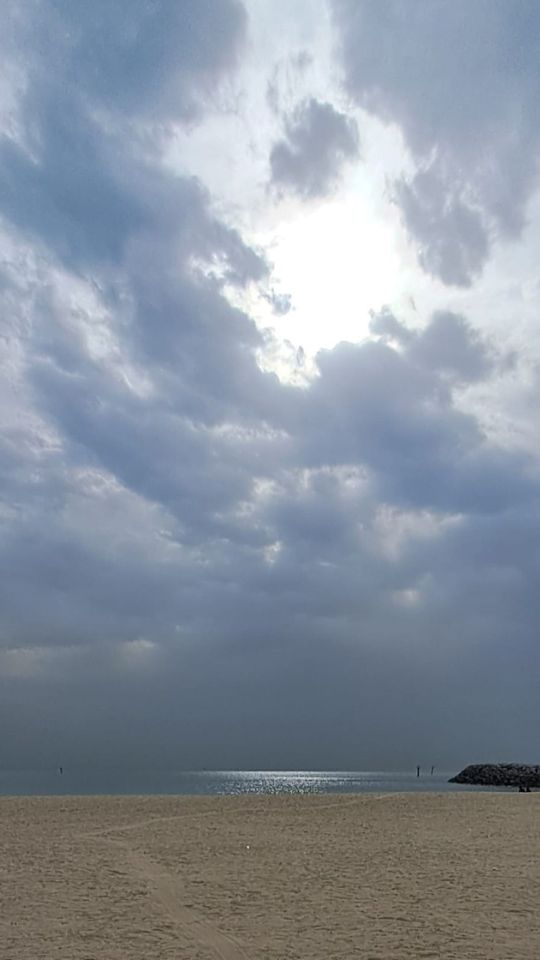
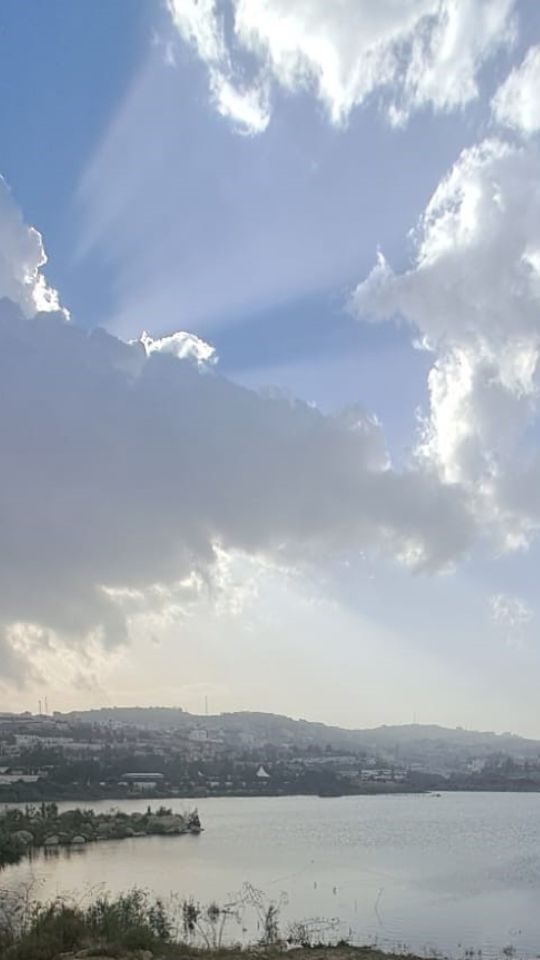
Shaped like a dome the limitless sky is set up like a giant canvas, where ‘Al-Musavvir’ enthralls us with various strokes of HIS brush. Sometimes clouds are arranged as straight lines, sometimes round and buffy, and sometimes a mixture – random and yet not looking out of place..
Besides the enchanting nature, the limitless sky also has something mystical. At times when I have felt helpless, overcome by sorrow, or burdened by stress, I have stood and stared up at the sky, calling to Allah Almighty. And immediately grief would be replaced by relief, sorrow by happiness.
In Tafsir Anwar Ul Bayan, Maulana Ashiq Ilahi narrates the 10 benefits of looking at the sky.
1. It reduces sorrow 2. It decreases negative thoughts (waswasa) 3. It eliminates fear and doubt 4. It helps in the remembrance of Allah 5. The heart fills up with Allah’s greatness 6. It removes harmful thoughts 7. It is beneficial during melancholic (Saudavi) conditions 8. Provides comfort for the longing heart. 9. Bring closeness towards family and friends. 10. It gives a direction for us to make supplications (duas)
Even when the sky is clear it still manages to dazzle with a variety of colors merging into one another.
And then, as if providing a final crescendo of an already breathtaking performance, the sky decides to participate with other wonders of nature like the never-ending ocean and the strong as-ever mountains. The views are just Enthralling and Captivating.
The limitless sky is accessible to everyone. Rich or Poor. Busy or free. Traveler or nontraveler. The limitless sky is accessible to everyone – including you!
No matter how busy you are, I hope you can find a few minutes to pause your life and look at the sky (hopefully not while driving or crossing the road). And when your heart is filled with wonder remember to remember the ‘Al-Musavvir’ in HIS own words.
23:14 So, glorious is Allah, the Best of the creators
Khushu and Khuzu are the essential states during Salah/Namaz. Some scholars have even called it obligatory. However, the most common view that most scholars have taken is that the benefits of Salah will start if it is offered with Khushu and Khuzu.
Khushu means to be in a state where your heart and mind are empty of all thoughts and you are fully focused on what you are reading in Salah. And Khuzu is a state in which the body stays still and avoids any type of extra motion e.g. scratching, yawning, flinching, or moving needlessly.
A Salah offered with Khushu and Khuzu has many benefits. The benefits can be felt more than they can be explained.
Khushu and Khuzu can be obtained in many different ways. Khuzu, the stillness of the body can be easily achieved by trying and making an effort.
Khushu, however, requires more inner work. Khushu that is the emptying of mind and heart from all thoughts, can be achieved by
Moving your mind from the thoughts that are generated in your mind to the words that you or the Imam are reciting.
Memorizing new Surahs or portions of Surahs with meaning and reciting them during Salah.
Telling yourself that Allah is much bigger than the thoughts being generated in your mind.
Imagine that you are meeting Allah or that one day you will meet Allah.
Salah is the connection between us and Allah and the stronger that connection is, the more beneficial it would be for us. If we want to realize The Pakistan Dream we need to make an effort to offer Daily Salah with Khushu and Khuzu.
Political debates are pretty common in our country. Usually, they’re about “who is better for Pakistan.” Rarely do they focus on “what is better for Pakistan.” If we look at the manifestos of all political parties, military rulers, and even caretakers, we’ll find a few common themes: education, poverty alleviation, increasing exports, stronger defense, more jobs, and fighting corruption. But if we dig deeper into their hidden agendas, it all comes down to one question: “How do I come into power and how do I stay in power forever?”
My point is that none of these published or unpublished manifestos, really serve Pakistan because they fail to answer one crucial question: “Who has given us the right to rule?” This question matters because we are accountable to whoever gave us that right.
In the Quran, Allah says: …Allah gives His kingship to whom He wills. (2:247)
This means that Allah gives us the right to rule, making the rulers accountable to Allah and Allah alone. Not to the establishment or judiciary. Not to the various mafias in real estate, agriculture, retail, or sugar. Not to the various superpowers or ‘brotherly’ Arab countries. Not even to the people of Pakistan. The rulers are accountable to Allah and Allah alone. And the reason that the right to rule is given by Allah, is to implement the laws that He has mentioned in the the Quran and Sunnah.
This important factor is not just ignored by our ruling elite but also by us. We too have been given a right to rule—a right to rule over our families, homes, and employees. And most importantly, a right to rule our own lives. We too are required to implement the laws of Allah in the domains that are given under our control.
The real change will come in our lives and our country when we accept this one important fact: Our lives, our children, our money, our fame, our rules, are all given by Allah and Allah alone. And they have been given to us for a reason, which is to implement the dos and don’ts as specified by Allah in the domains that we rule over. Have we done so? And if not, what right do we have to criticize someone who has not implemented them? What right do we have to criticize the rulers of our country? In Pakistan, implementing the laws of Islam is not difficult. In fact, they are quite easy and facilitative. If we still have not implemented these laws or agreed to implement them, then as far as I am concerned, we have no right to criticize anyone else, be it our neighbors, friends, or even our political elite. Everyone is busy disobeying Allah, and we are Everyone.
Living the Pakistani dream means having a strong connection with the Holy Quran. Quaid-e-Azam Muhammad Ali Jinnah, the founder of Pakistan, had made it clear that Pakistan would be a state where the laws of the Quran and Sunnah would be implemented and followed. That was the basis of the Two Nation Theory as well. In this blog series, I will relate to my journey of connecting with the book of Allah – The Holy Quran.
The Holy Quran was revealed by Allah on HIS messenger Prophet Muhammad (peace be upon him) almost 1400 years ago. Before the Quran, Allah had revealed the Torah on Prophet Musa (Moses), Psalms (Zaboor) on Prophet Dawood (David), and the Gospel (Injeel) on Prophet Isa (Jesus) (peace be upon them all). The present-day Bible is believed to be a combination of the Torah, Psalms, and the Gospel. All the holy books were revealed hundreds of years before the Quran.
Quran was revealed in the Arabic language. It has a little over 600 pages and around 77,000 words. The Quran is arranged in 114 Chapters (Surahs). The chapters are arranged in around 30 Juzs or parts.
Starting from my early teens I have been attending the Taraveeh Prayers during the holy month of Ramadan in Masajids, all over the world. I remember being amazed at how the Qura (reciters) could recite the entire Quran from just their memory. It was probably from that time that the many wonders of the Holy Quran started to appear before me. Almost 30 years later, as I write these words, the Holy Quran has not stopped to amaze me. Recently, while reading Maariful Quran, I found that many books have been written on the wonders and miracles of the Holy Quran. In itself, it is a wonder that the Holy Quran has had this effect on so many people before me and I am sure so many people will continue to feel the same after me as well.
I hope that you enjoy reading this series, as I enjoy diving deeper into the wonders of the Holy Quran.