Decoding Poetry 

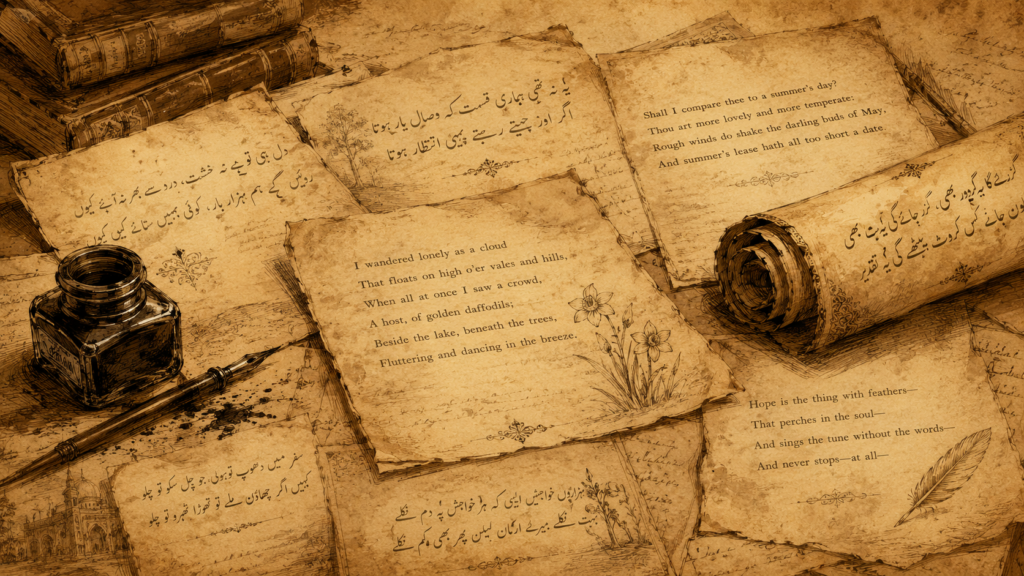
One of the many things that I inherited from my father was his love for poetry, specifically Urdu Ghazals. Poetry appears in many forms: poems, ghazals, nazms, sonnets, odes, elegies, ballads, free verse, etc. Personally, I love anything that rhymes.  

Poetry is quite powerful as well, if you get the hang of it. When I am able to connect with the seemingly un-seeming words of a poem, I am hooked. It feels like magic as it makes me start looking at the world in a different light. No wonder Poets were both chastised and cherished by powerful governments right through history, just because poems have the ability to stir the masses. Our own Allama Iqbal is rightly credited with instilling a sense of unity and belonging in our struggle to form a country for the Muslims of the subcontinent.  

The beauty of poetry, whatever language it may be in, is that its real meaning is often hidden behind layers, which one has to peel back to reach the heart of it. 

So over time, I developed a simple method to understand poetry. 

1. Read the poem. ‘Duh. That’s so original!’  you might say. But the reason I mention this is that you might get frustrated because the words are too difficult, OR you don’t understand the meaning or context. Don’t worry, that is normal. Just keep reading and finish the poem in one go.  

2. Highlight the difficult words and find their meanings. In the age of AI, you can find the meanings very quickly. I normally take a picture and put it in Gemini and ask it to give me the meanings of the difficult words. I do still highlight those words and write their meanings inside the book. It saves me going back and forth between the book and Gemini during my multiple re-reads.   

Read the poem again. At this point, the first layer should be removed, and the literal meaning would be surfacing.  

3. Find the hidden meanings. This is where the magic lies, and it requires a little bit of effort. I call this as ‘finding the meaning of the meaning’ or what the poet actually means. This step is important and would need a little bit of research on the poet and his worldview.  

Because great poets do not write about just anything. They write about things that matter the most to them. Things that make them emotional. So to peel this layer and get to the hidden meaning you would have to find answers to some questions about the poet like ‘the times the poet lived in’, ‘what were some issues that society was facing at that time’, ‘what were some issues that the poet was going through’, ‘what did the poet normally write about?’, ‘what was his world view’, ‘what images or styles did he normally uses’.  

Again, Gemini is a great time saver here. And normally, you would have to do this once for one poet. Because things that matter to great poets normally do not change in their lifetimes. Also, a poet hardly changes his style, e.g., a poet may use nature to explain his take on life. , 

Note that you might not agree with the poet’s worldview, but it is still important for you to understand where he is coming from.   

These three steps are most important, and let us study them with an example.  

e.g.  

The Woods are lovely, dark, and deep 
But I have promises to keep 
And miles to go before I sleep 

Here, the literal meaning can be that the poet likes the woods and likes to watch them. But he has some other work and wants to do that.

But this literal meaning is not very magical. Is it? So we have to ask some questions about the poet. Robert Frost loves nature. His poems, at least the ones I have read and loved, are all about nature. But he also relates them to life and choices in life.   

So if you understand Frost’s style, you might peel the next layer and see that by ‘woods’ he means the ‘world with all its attractions’, and by ‘promises’ he means ‘responsibilities’ and by ‘sleep’ he means ‘death’. So the meaning of the meaning becomes that although he loves many things that the world has to offer, he has many responsibilities that he needs to fulfil and cannot ignore. And these responsibilities are so many that he denotes them by ‘miles’. And perhaps it would take a lifetime to fulfill them. But maybe somewhere along the way, he would find some other attractions like this and would just pause for a while to enjoy them, and then he would move again.  

This is what I mean about finding the meaning of the meaning.  

If you want, you can stop here. But I have a few more steps. 

4. Find your meaning. You don’t need to go with what the poet probably meant by his poem. Poems, Ghazals, and Nazms are so full of options that you can draw your own meaning. For example, in the lines above, I like to draw a meaning that connects with my own being and its relationship with my Creator — the magnificent Allah Almighty — and with the attractions that Allah Himself has placed in this world for us. 

If I use these attractions to pause for a while, enjoy them, and re-energize myself, then they are helpful. But if I allow them to make me forget my responsibilities and the purpose of my life, then I am at a loss. 

5. Listen to a good orator so that you can know how to recite the words with correct pronunciation and weight. I love doing that. Because it helps me read with emotions.  

6. Finally, read it many times and also explain it to others. Often, I explain a new Ghazal or poem that I have decoded to my kids or my wife. Sometimes the expression on their faces, when they get to know the actual meaning,  is priceless. Many times, they explain the meanings that they understood to me, which I love even more. Most importantly, this helps me memorize the poem.  

Well, that is it for today. I will leave you with a poem by Robert Frost, and you let me know in the comments your meaning! 

Nature’s first green is gold 
Her hardest hue to hold 
Her early leaf’s a flower 
But only so an hour 
Then leaf subsides to leaf 
So Eden Sank to Grief 
So dawn turns down to day 
Nothing Gold, can stay. 


Enjoyed reading? Join my WhatsApp Channel for daily updates and let me know what you think.

The Fifth Discipline – My Book Notes

These are my notes from the book – The Fifth Discipline by Peter Senge

About the Book

Full Title: The Fifth Discipline – The Art & Practice of the Learning Organization
Author: Peter M. Senge
Publisher: Penguin Random House
Read On: Kobo Books (April ‘2005 to July 2025)
Year Published: 2006 (Originally published in 1990)
Short Summary: The Fifth Discipline is about how individuals and organizations can achieve lasting change by thinking in systems, challenging assumptions, and continuously learning together.
About the Author: Peter M. Senge is an American systems scientist, organizational theorist, and senior lecturer at the MIT Sloan School of Management. He is best known for his work on organizational learning, systems thinking, and leadership development.

Book Summary

For individuals and organizations to deliver lasting positive changes and not be one-hit wonders, Peter Senge offers five disciplines, that need to be implemented in the DNA of individuals and/or organizations (whomsoever wants a lasting positive change)

These five disciplines are

  1. Personal Mastery → Lifelong learning and growth by aligning actions with personal vision and truth.
  2. Mental Models → Becoming aware of and challenging the assumptions that shape how we think and act.
  3. Shared Vision → Building a common, genuine purpose that motivates and aligns people.
  4. Team Learning → Developing group intelligence through dialogue, reflection, and coordinated action.
  5. Systems Thinking → Understanding interconnections and feedback loops to see the whole system—not just parts.

The Fifth Discipline is Systems Thinking, which, as per the author, ties all the other disciplines together.

My Notes On The Five Disciplines

The five disciplines are the meat of the book, so below is a summary of each of the five disciplines as I understood and learned from them.

Personal Mastery

  1. Commit to lifelong learning. Lifelong learning means, as my father used to say, A man learns from the cradle to the grave.
  2. Learning should not be random; instead, it should be aligned with my vision and purpose in life.
  3. Get out of your comfort zone. I should not spend too much time on things that I am good at and/or comfortable with; instead, I need to spend more time on things that I am mediocre at or not very comfortable with. This will enhance my learning.  Somerset Maugham said, “Only mediocre people are always at their best”.
  4. Stay between rationality and intuition. Rationality is the result of deep thinking and reasoning, while intuition is a spark, an idea, or a completely random thought. Stay between both of them. Don’t drop one for the other.

Mental Models

  1. Be mindful that my thinking and decision-making are heavily influenced by, and sometimes even dependent upon, my biases, my deeply ingrained beliefs, assumptions, generalizations, and internal pictures of how the world works. If the need arises, be prepared to challenge these mental models.

Shared Vision

  1. Vision is concrete; purpose is abstract and enduring. Purpose is where I want to go and why. And vision is ‘how’ I will get there.
  2. There is a tension and resulting stress because of the distance between my current reality (where I am) and my vision (where I want to be). This tension is good because it is the fuel that will drive me forward.
  3. Being a visionary leader is about solving day-to-day problems with my vision in mind.
  4. Having a vision is something that needs to be internalized. So that all my decisions, thoughts, and actions are aligned with my vision. My purpose (link) is to ‘get closer to Allah’, and my vision is ‘before doing anything, think how I can seek the pleasure of Allah in what I am doing’. The daily actions that I do concerning my family, myself, my job, my worship, etc., all should be aligned with this purpose and vision.
  5. It is not what a vision is; it is what a vision does.

Team Leaning

  1. When I am leading teams and even family, I should have open dialogue and discussion. Each member of the team should feel safe to have this dialogue and discussion with me.
  2. In team meetings, I should encourage silent members to bring their point of view and thinking to the table. This should be done repeatedly so that the team understands the culture and eventually feels free to contribute.
  3. I should not overpower my team with my thinking and my vision. I should let them evolve their own visions. As long as we are all aligned with the company’s vision and the greater good, we are fine to carry visions of our own.

Systems Thinking

This is the fifth discipline. And probably most critical to understand, because, as per Peter Senge, it ties everything together. The following concepts need to be understood, which I feel are beneficial about systems.

  1. Systems Thinking is the discipline of understanding how parts interact to form a whole, and how it helps to see Patterns, Connections, and Root causes.
  2. Delays are time lags between action and outcome. Delays often mislead people. They might think, e.g., that result c is because of action 5, but a deeper analysis of the system (systems thinking) would reveal that it was actually because of action 2. Delays are something that I should be mindful of and should not jump to conclusions.
  3. Leverage Points. They are small, well-placed actions in a system that lead to large, sustainable improvements. It’s like a snowball effect, but in the right direction.
  4. Systems usually fail because of ‘Shifting the Burden’ and ‘Limits to Growth’
  5. In every system, there are two types of internal systems – one that is trying to increase output and the other that tries to maintain stability by resisting change. They are known as
    • Reinforcing loops are systems that amplify change (growth or decline)
    • Balancing loops are systems that resist change (growth or decline) and maintain stability.

Understanding Reinforcing and Balancing Loops.

One of the reasons that systems fail might be due to the ‘Limits to Growth’ principle. Here is how it usually plays out.

  1. Reinforcing Loop (R): Growth leads to more growth. E.g., more customers → more revenue → more investment → more customers
  2. Balancing Loop (B): A hidden constraint begins to push back.
    E.g., staff burnout, supply chain bottlenecks, quality issues

The result is that growth stops or even starts to reverse. The solution is ‘Don’t push harder – identify and address the limit’. Remove the ‘dead pony’ from the well.

Heisenberg’s Uncertainty Principle

Heisenberg’s uncertainty principle, when applied to systems thinking, means that sometimes you cannot observe the system without influencing it. e.g., I cannot observe the engineers supporting the helpdesk system without affecting their performance. So sometimes, in order to observe a system, some different methods might be needed.

Power of our subconscious

An effective way to focus the subconscious is through imagery and visualization. For example, world-class swimmers have found that by imagining their hands to be twice their actual size and their feet to be webbed, they actually swim faster. “Mental rehearsal” of complex feats has become routine psychological training for diverse professional performers.

My Thoughts About & During the Book

  1. It was a good book. Some of my concepts were reinforced, such as what is called in the book ‘Systems Thinking’.
  2. The book was not a very easy read. I had to read and reread some passages. Sometimes I felt lost. Reading the table of contents and also discussions with ChatGPT helped reinforce my understanding and internalize the concepts.
  3. I do not see the five disciplines beneficial as a single framework. But I did find parts of the book very helpful. Especially the parts where it explained the System Thinking with (Reinforcing and Balancing Loops) and the ‘Limit to Growth’ and ‘Leverage’.
  4. The book is too heavy, meaning too many words, pages to explain simple things. Most of it felt redundant. I skipped the 2nd and 3rd parts (which were almost half of the book) as it felt more like marketing fluff to me. Some of the success stories revealed in these sections seemed to me were twisted to make them fit into one or more of the disciplines.
  5. I tried to understand Systems Thinking and feedback loops by linking it with Imran Khan’s and PTI’s rise and fall (and possibly another rise). That was an interesting discussion with ChatGPT, and maybe I will write about it someday.

Conclusion

Overall, it was a good book that everyone should read at least once.


Enjoyed reading? Join my WhatsApp Channel for daily updates and let me know what you think.

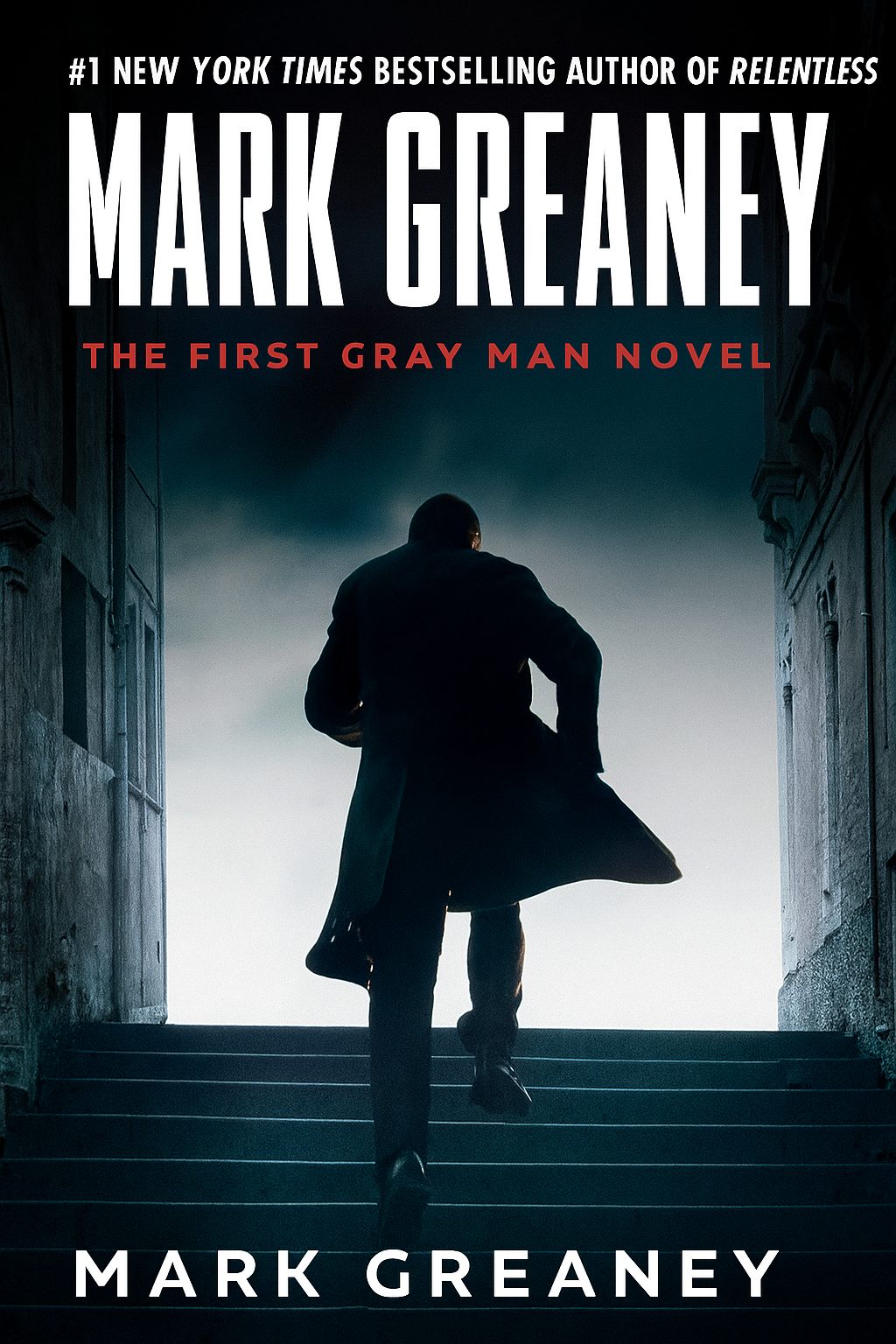
About The Horrendous Book: Gray Man

Finally I get to use the word Horrendous for a book. Normally my policy is that all books are good if we are able to connect with them. But this book by Mark Greaney is absolutely horrendous. And if I may, wildly inaccurate.

I am not a big fan of pantsers

First of all, Mark Greaney is a pantser, and I am not a big fan of pantsers. Pantsers just wash their face in the morning and start typing whatever is coming into their heads. The drawback of this approach, especially if the author is not very good at crafting a good story, is that the writing is not very consistent. Each chapter or section probably matches more with how the author felt during the writing session and not how a story should be. You can forget consistency, character building, and deeply connected and intricate plots. Although I enjoy books from pantsers like Stephen King, because they are fast paced, but Mark is not a very good pantser.

Okay, we get it, Court Gentry is the best spy / secret agent in the whole world. But eleven chapters (and counting) to tell us about it is just too much

The horrendipity (I made this word so don’t bother searching for its meaning) of this horrendous book starts with the author detailing how great is the protagonist Court Gentry. He seems to have a crush on Court Gentry, and that crush lasted the first eleven chapters and maybe more, because I just couldn’t take the torture anymore, so I didn’t read the book after the first eleven chapters. But in reality, there is nothing unique, new, or special about this character. In fact, the first eleven chapters that I read (and the only ones that I read), showed Court Gentry to be a cheap copy of Jason Bourne and Jack Reacher.

Telling and not showing!

Maybe I would have been able to digest this extraordinarily long explanation of the goodness of Court Gentry if the author had stuck to showing and not telling. Chapter after chapter kept on telling (and not showing) Court Gentry’s skills and specialities. My conversation with the author while reading the book was like.

Author: Court Gentry is this.
Me: WOW!
Author: He is that.
Me: WOW.
Author: He did that.
Me: Okay.
Author: And that.
Me: Umm, okay, I get it. He is the best thing that happened to the fictional world of spies after Jason Bourne. Can we please proceed with the plot?
Author: Yeah sure, but you know what else he did.
Me: I will die if I read another page!

Don’t use global events incorrectly – the reader will feel stupid

Whenever you embed global events in your story, make sure to keep the context and background as real as possible. Otherwise, don’t use the global event to create a fictitious event. If you do use the global event without the correct context, you would look very stupid.

For example. Iraq War. His opening chapters paint Iraqis as the bad guys as they dance on the dead bodies of Americans while Americans were just going about their business. But the real context of the Iraq War was totally different. Americans attacked Iraq on the pretext of ‘Weapons of Mass Destruction’, which was a lie. Americans entered Mosques with boots, and pictures from Abu Gharaib prison showed Americans doing satanic voodoo dances with prisoners in chains. I mean, how dumb can some authors think that their readers are? If you read these chapters with the actual background, then Court Gentry does not look like a saint as the author wants to show him. This throws the whole believability of the book into the gutter.

A few chapters later, the Gray Man, probably called Gray because he operates between black and white, is shown to have fought a Pakistani Mafia in the UK! (I couldn’t complete this chapter, and this is where I left the book, because this is where the stupidity of the book was too much to take anymore.) I mean are we supposed to believe that MI6 is failing to defend the family of a MI6 operative against the Pakistani Mafia in the UK? I mean, get real, please!! The Pakistani Mafia is not that strong in Pakistan. They are repeatedly smashed around by Pakistani Intelligence operatives, and you want me to believe that the Pakistani Mafia in the UK is stronger than all of the UK’s security apparatus and only Court Gentry is able to fight them! Again, how dumb do you think that your readers are?

Maybe if the author would have shown another world or a future that we have not seen, then I would have believed the plot. As a person who knows a little about current global events, societies, and politics, I felt like the author thinks of me as a dumb person.

Is the protagonist actually ‘Gray’?

Mr. Court Gentry called the Gray man because he operates between Black and White, is continuously shown to be doing the right thing, or in other words, the White thing. So why call him Gray? He is a Robin Hood who only takes on projects against criminals. He protects his friends, he protects Americans, and even twin girls. Awww. So Sweet! But this is all white, isn’t it? Why the hell is he Gray then? Either don’t tell me he is gray, or mix the white and black things that he has done in his past to make it more believable. Maybe he sold drugs, or he rapes women, or maybe he killed innocent men, women and children before repenting. I mean that would make him Gray.

This, in my opinion, is the worst side of Pantsers. The author might have thought ‘Oh, Gray Man, sounds good. Let’s keep it, even though Court Gentry does all the right things for the right reasons. The readers would just have to go with it.

Conclusion

If you like shallow action (and storytelling), are willing to ignore global context, and want to read about a cheaper version of Jason Bourne and Jack Reacher, maybe you’ll enjoy this. I didn’t. I stopped torturing myself at the beginning of the eleventh chapter. Best of luck to the author, I know that he is doing great and getting movie contracts and teaming up with other pantsers. But I have better books to read and intelligent plots to uncover.


Enjoyed reading? Join my WhatsApp Channel for daily updates and let me know what you think.

5 Ways to Effectively Remember What You Read

Let us talk about a common problem that most readers face. How to remember what they read?

1. Pick the Book that you are most curious about.

I always have hundreds of books on my ‘To Read’ list. But my next book is always the one that intrigues me the most. When you are curious you have many questions you want answered, which means your brain is prepared to accept and store related information.  This active, unforced participation of the brain cells results in enhanced comprehension and retention.  

2. Read the table of contents and the Preface before you start the book

The preface of a book would help you form an idea of the author’s writing style and most importantly how he plans to explore the topic. Additionally, it might also give you an idea of his worldview.

From the table of contents, you can find the list of sub-topics included in the book and their arrangement. This helps to create a map of the book in your brain and at any point in time you would know where you are, where you have been, and where you are headed. This sense of awareness will give you added focus helping you to retain more information than otherwise.

3. Do Not Speed Read

Rather than develop their understanding most people prefer speed reading. Research, meanwhile, has shown that the faster you read the less you understand.

So quit speed reading. You can be very selective when choosing a book to read. But once you have selected a book, prepare yourself to spend time with it. Give pauses and take breaks to let passages synch into your brain. Think about what you are reading. Question. Argue. Agree. Disagree.  Relate. All of this would increase your retention. Re-read any passages you find unclear.

The only times that I would suggest speed reading or even skipping portions is when you feel that the author is being repetitive.  

4. Summarize in Your Own Words

Summarize each chapter in your own words. Highlighting is great, but it’s even better when you add your notes explaining why the highlighted section is important to you. At the end of each chapter and the book, try writing a summary that includes both the author’s views and your thoughts. Which parts do you agree or disagree with the author? Which parts do you relate to the most? This active engagement helps you remember the content long after you’ve finished the book.

5. Compile The Notes.

Compile your notes on a single page. I prefer OneNote but you can use any tool that works for you. While compiling you may want to add more text to an existing note. Edit them if needed. Arrange them. Include the chapter and book summaries as well. This revision will help to reinforce the notes in your memory. Plus, these notes will help you whenever you need a refresher. You can quickly glance at your notes and jog your memory.

I hope you list this short checklist. If there are some tips that you follow to remember the information, do share in the comments below.


Enjoyed reading? Join my WhatsApp Channel for daily updates and let me know what you think.
On Reading Books To Gain Knowledge

Introduction

To realize The Pakistan Dream you need to gain a lot of knowledge and develop many new skills. To do that effectively you would need to read many books. Some books might be assigned to you as part of a college/university course while you might choose others to develop your understanding in a particular area. For you to read, understand, and remember hundreds of books that you will read throughout your life, you would need to develop your reading skills. In this blog, I will be sharing some tips on how you can do that.

How to classify the books you want to read?

While you might not have much say about books that are assigned to you as compulsory reading, there should be a method to select the books that you choose to read. Irrespective of the classification of books in libraries and bookstores, it will be better to categorize your reading list into categories that are meant to answer the basic question of ‘Why you want to read a particular book’. ‘Adler Mortimer’ in ‘How to Read a Book’ categorizes them into

Books meant to entertain you. These would be fiction novels of various genres like fantasy, drama, mystery, poetry, etc. They are meant to be read to enhance your imagination and emotions. I also include non-fiction books on history, politics, biographies, etc. in this category, since I read them for entertainment.

Books that are meant to provide information. These are the books, magazines, or newspaper articles that provide the latest information and updates about topics that you already understand and have some level of expertise. In my case, articles and books on Information Technology, Leadership and Management, etc. are the ones which I read to update myself as I already have considerable understanding about these subjects.

Books that are meant to enhance knowledge. These are books on topics that you do not understand e.g. for me, these would be books on financial investments as I am interested in increasing my understanding of the subject but currently know way too less about it.

About the books read to enhance your knowledge

For the books that you read to enhance your knowledge, it is important to remember the quote of Francis Bacon in his essay ‘Of Studies’ where he mentions that some books are to be tasted, others to be swallowed, and some few to be chewed and digested.

It will be good to understand what is meant by taste, swallowing, and digesting a book.

Tasting a book means a superficial reading of the book. You skim through the book rapidly picking up the main ideas or some practical tips. You can highlight the important parts. Nowadays with the introduction of ChatGPT, I just ask the AI engine to summarize the book and highlight the important parts.  

Swallowing a book would mean more intense reading to try and grasp the ideas and arguments presented in the book.

Digesting a book would mean not only reading the book but also contemplating it. Such books present ideas that are new to you possessing the ability to evolve and upgrade your thinking. Generally, such books would give you a new way of thinking or even motivate you to alter your lifestyle.

Increasing your net worth

Your knowledge will increase when you read books on areas that you know nothing or little about. The more varied areas you gain understanding and knowledge about, the more connections you would be able to form in your brain and come up with better solutions to problems that you or society faces. Reading such books would be the difference between you and your peers who prefer to read only novels, newspapers, or worse – social media feeds. Let me give you a simple example.

Suppose you are a fresh graduate of computer sciences with a major in software development. Besides your knowledge of software development and deployment, if you can invest time to read a book and learn about the basics of accounting and finance, your net worth will increase immediately. As it makes you capable of either making a new or understanding existing software on finance and investments, much more easily than your peers who only know software development. Software such as SAP or Oracle Financials are critical for the operations of major corporations worldwide and thus would open a lot more options for you in the market than your peers, hence increasing your net worth. All of this is because you chose to spend a few weeks enhancing your knowledge about accounting and finance by reading, understanding, and remembering a few books on the topic.

The difficulty in reading books to enhance knowledge

Reading such books, though, would pose the highest level of challenge. They would require more time and effort to read, understand, and remember. A reading session of such books should leave you more tired than reading sessions of books that you read for amusement or information.

The cumbersome process of reading, understanding, and remembering such books would mean two things (a) you would have to select the right books (b) your reading process must be different than the reading process of novels and newspapers.

The whole process of reading, understanding, and remembering books might take you anywhere from a week to a month to a year. This is a considerable investment of your time; therefore, you should be careful not to select books that would waste your time and effort.

Similarly, the reading process by which you read books to develop your knowledge must be different from the books you are reading just for pleasure. The process of reading books to enhance your knowledge would require you to take notes, re-read passages multiple times, and read supporting literature. Something which you would never do when you read a novel or a newspaper. That is why ‘Adler Mortimer’ mentions in ‘How to Read a Book’ that these would be the books that would leave you the most fatigued.

In the subsequent sections, I will be giving some tips on selecting books and the reading process.

How can you select books?

Books can be recommended to you, enforced on you (as part of a curriculum or course) or you might develop a curiosity to read a book. You might also want to read books to develop an understanding of a specific area. Unless the book is part of compulsory reading you have a choice whether to read the book or not.

As mentioned in the last section; reading, understanding, and remembering, or in other words digesting books require a significant investment of your time, therefore it would be better if you ask a few questions before you start reading a book.

Find out what is the Book About

When you go to a bookstore or a library, you see many books. Some with shiny front covers and/or titles that are designed to attract you. Before you give in to their charms, it will be good to check what the book is about. You can find that out by

  1. Read the Book Title, Subtitle, and Table of contents. Skim through the Introduction/Preface of the book. After doing that ask the question, are you still interested?
  2. If you do not have a specific book in mind but rather want to increase your knowledge in a particular area, find the best books in that area and read their reviews. Give weightage to reviews by specialists in that area. Are they recommending some other books? You can also consult specialists of the field that you know on the books that they recommend.

Find out about the Author.

  1. Who wrote the book?
  2. What is his worldview?
  3. What is his expertise on the topic? 

Why Would You Want to Read The Book

Finally, ask these questions to understand why you want to read the book.

  1. Why do you want to read the book? For Amusement, Information, or Understanding?
  2. Which existing or future role would the book help you in? Are you about to move from a technical to a managerial role? Are you about to get married or have a child?
  3. Do you want to extract practical tips from it or do you want to enhance your understanding and increase your net worth?
  4. Are you interested in critiquing the book and challenging the author and his assumptions?

Asking these questions would help you decide not only whether you want to read the book or not, but also how fast you want to read it and what your reading process is going to be. This would lay the groundwork for the next section on ‘How to Read’ this particular book.

How to read a book to understand and gain knowledge

As explained above, for the books you are reading to enhance your knowledge and understanding you need a method to read such books so that you can maximize the knowledge that you extract out of the book. Below are some guidelines that might help you out in reading, understanding, and remembering what you read in these books.

Understand the structure

Start by reading the title, subtitle, table of contents, and preface of the book. Make sure that you understand how the book is arranged and the various topics and sub-topics it attempts to cover. This would make a mind map or skeleton of the book in your mind. For complicated books, you might want to write the structure/skeleton in a separate notebook and keep on adding to it, as explained later.

Trying to understand the structure may also help you in finding out which portions (if not all) are more relevant to you.

Understanding Important words, terms, and passages

Important Words and Terms. When you come across important words or terms, make sure that you understand their meaning and the context in which the writer has used them. Do not proceed before you are sure that you understand them. A word can have multiple meanings. The author might be using the word with a meaning that is different from what you know it to be. The author might be using it as jargon, or he might not agree with the way that the word is generally defined. Good authors explain the meaning of such words and the context in which they have used them. Therefore, it is important to read such words and terms carefully and be sure that you understand how the author wishes to use them.

You can find important words and terms by noticing that.

  1. The author has highlighted such words.
  2. The author is arguing about the general definition of the word.
  3. The author has used the words or terms in the title and the preface.

Important Sentences and Passages. Note the important sentences and paragraphs and ensure that you understand them before you proceed. Important sentences or passages might be the ones where the author is

  1. Providing a solution or some practical step(s) to overcome problems.
  2. Have mentioned something that is most relevant to you.
  3. Trying to form an argument and providing his understanding of it.
  4. Giving evidence to prove his argument.

You can judge if you have understood these important passages if,

  1. You can summarize them in your own words.
  2. You can explain the author’s arguments to another person? Imagine yourself in front of a class and explaining the topic.

If you cannot then it means that you might not have understood this important passage and should be re-reading the passage as many times as it is necessary.

Note Taking – Maintain the structure.

Note-taking will be the most important step if you want to remember what you have read and understood in a book. Therefore, it is important to start by creating a mind map of the structure of the book in a separate notebook or blank paper. You might want to create some additional maps as well e.g. when I read books on history, I tend to make different kinds of notes e.g. world map of the time, a family tree telling me, who is related to who, and an important dates e.g. date of the war, date of a birth or a death, etc.

Once a structure or a mind map is created, you need to keep it updated as you read the book. You can update it by adding (a) subheadings (b) arguments/propositions (c) important paragraphs

This structure or mind map will serve as your index and might look different from the index or table contents provided by the author. Make sure that what you add to the mind map are just single words or terms or very short sentences. The real meaning is to be understood and not be written in the mind map.

While reading you might get a lot of thoughts or arguments for/against the passages you are reading. You can capture your thoughts in a separate notebook, but always, focus more on understanding the author’s POV. Make sure that your notes are written separately in your notebook as at this point you do not want to mix your inputs with what the author is trying to tell you.

Okay to Skim through some parts

Some passages in the book might not be relevant to you or your understanding. It is okay to skip them to save time and effort. But it is a good idea to add the passage/heading/chapter that you are skipping in the mind map or the structure of the book that you are maintaining in a separate notebook. I generally tend to avoid but if you want you can mention the reason you are skipping the part. I usually use a red pen for such portions and do not usually write the reason, since I would be able to tell by just reading the topic name that I have put.

Completing the Reading

  1. Upon completion of the reading, review the structure or the mind map of the book that you have been updating throughout the reading of the book. Are you able to understand all the parts mentioned in the structure? If not, read those parts again.
  2. If you can understand, try to write a short unity statement. e.g. The book believes xxxx is a problem and provides yyyy, zzzz, aaaa as arguments. Finally, it gives the proposal and solution of pppp and qqqqq to solve those problems.
  3. Writing the unity statement would help you summarize the book into a very short passage of your own words. When you can do that, you have understood the gist of the book. This would help you in (a) Explaining what the book is about when someone asks you about what you have learned from the book, and (b) Making you remember what the book is about so that you may refer to it, anytime you wish to in the future.
  4. Preserve the mind map and the unity statement in your file (online or physical) as a note. Make sure that you read these notes frequently to preserve the message of the book in your memory.

Some additional activities after completing a book

The following are some additional steps that you might consider taking once you have completed the book. These steps would help you in re-enforcing your understanding and help you remember the key areas from the book.

Critique the Book

  1. Review the mind map, unity statement, and other notes that you might have written regarding the book. Ask yourself are all the propositions and arguments presented in the book explained and answered? If some are missing or you do not remember, read the marked passages again, using the structure you have been maintaining.
  1. Find out which arguments the author failed to answer, and which problems were not solved. Or not solved to your satisfaction.
  1. Do you agree with the arguments, proposals/solutions provided in the book? If not, why not? Write it, in your own words.
  2. Make sure to clearly state the argument and the provided evidence. (or opinion)
  3. Provide your counterargument with evidence.

More Reading?

Maybe the book has not fully satisfied your thirst for knowledge on a particular topic. Assess whether the missing arguments can be answered from other books. If yes which ones? Are you interested in reading them?

Some books provide references to other books as well. They are mentioned in the Bibliography or footnotes. I would normally highlight books that I am interested in reading later. It would be a good time to do some research on these books and decide whether you want to read them or not. 

Extract From Your Notes

  1. Extract quotes that you were moved by and write them in your Quotations Notebook. I maintain a separate notebook where I write quotations, lyrics, stanzas, etc. I read passages from my quotation notebook frequently. It is surreal.
  2. Extract practical steps that you feel would be helpful to solve a problem that you are facing. Arrange them into a checklist or a ToDo list.
  3. Extract the list of articles and books that you found in the book that intrigued you and add them in your ‘ToRead’ list. 

Write

Write an article/blog/book about the book. You have already written a lot of notes, so would not have to start from zero. In addition, you can mention

  1. What you have learned from the book.
  2. What you have implemented from the book.
  3. What you find missing in the book.
  4. What parts do you disagree with? What is your supporting evidence?

Share your work with people that you know would be able to provide good feedback and engage in discussion.

Conclusion

The steps might seem to be too much work but are necessary if you want to read, understand, and remember the important books that you read to understand. As you practice reading more and more complicated books, these steps will become second nature to you.

However, sometimes you might be tempted to skip all or some of the steps. It is okay if you do that. I do it as well. Sometimes some books are just too attractive to ignore. For such books going through the book selection process seems to be a waste of time. Give into the resistance and dive into such books head-on. If you wish, ignore even the note-taking and mind maps. Just read. If you feel the book is worthy enough you can always read it again to take notes.

I also find it helpful to make checklists of various things that I do repeatedly in my life. Checklists help me optimize the action. It also helps me to delegate the action to someone else by sharing my checklist. Book reading is also an action that we do repeatedly. So why not make a few checklists on ‘How to Select Books’, ‘How to Take Notes’, and ‘How to Read Books’? The good thing about checklists is that they are your processes and do not have to be perfect. You can always add/remove items. e.g. your checklist on ‘How to Select Books’ can start with two steps (1) Pick a Book (2) Read the Book. Later you can add more steps that you find relevant to your reading process.

Finally, I would say that if in a year you can read anywhere from 2 to 12 books to enhance your knowledge and understanding about areas which you knew little or nothing about, just imagine where your overall knowledge and understanding would be. Remember it is not about how many books you read; it is about how many you remember.


Do share your reading experience and tips in the comments section below.


Enjoyed reading? Join my WhatsApp Channel for daily updates and let me know what you think.
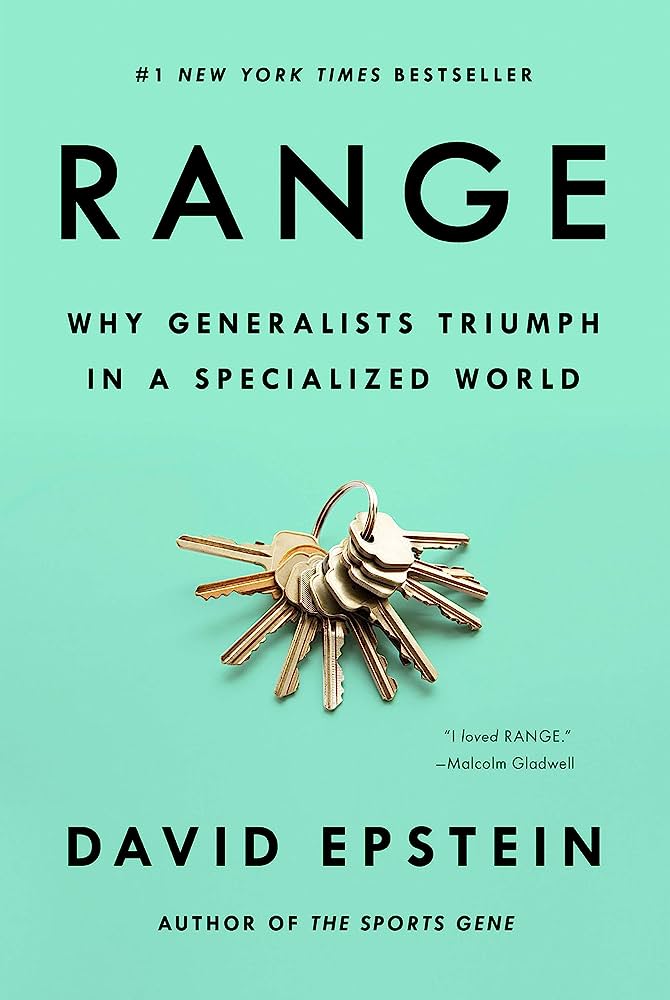
About the Book: Range: Why Generalists Triumph in a Specialized World

Author: David Epstein
Year published: 2019
Fiction/non-fiction: Non-fiction
Number of pages: 272
Cost on Google Books: $14.99
Amazon: 4.8 out of 5 stars
Goodreads: 4.4 out of 5 stars
Google Books: 4.9 out of 5 stars

Chapters List

  1. The Myth of the Early Start
  2. The Trouble with Specialization
  3. The Power of Breadth
  4. The Value of Delay
  5. The Importance of Failure
  6. The Virtues of the Dilettante
  7. The Generalist Renaissance
  8. The Future of Generalists

Short summary (without spoilers)

In Range, David Epstein argues that generalists, rather than specialists, are better equipped to succeed in the complex and unpredictable world of the 21st century. Epstein draws on evidence from a wide range of fields, including sports, business, and science, to show that generalists are more creative, adaptable, and resilient than specialists.

Epstein argues that the traditional emphasis on early specialization is misguided. He shows that many of the world’s most successful people, including Steve Jobs, Elon Musk, and Bill Gates, were generalists who experimented across different fields before finding their true calling.

Epstein also argues that the modern world is increasingly demanding generalists. In a world where jobs are constantly changing and new technologies are emerging all the time, it is more important than ever to be able to think broadly and learn new things quickly.

Long Summary (With Spoilers)

In his book Range: Why Generalists Triumph in a Specialized World, David Epstein argues that generalists, rather than specialists, are better equipped to succeed in the complex and unpredictable world of the 21st century.

Epstein begins by debunking the myth of the early start. He shows that many of the world’s most successful people, including Steve Jobs, Elon Musk, and Bill Gates, did not specialize early in their careers. In fact, many of them experimented across different fields before finding their true calling.

Epstein then goes on to explain the advantages of being a generalist. He shows that generalists are more creative, adaptable, and resilient than specialists. They are also better able to see the big picture and to make connections between seemingly unrelated ideas.

Epstein also argues that the modern world is increasingly demanding generalists. In a world where jobs are constantly changing and new technologies are emerging all the time, it is more important than ever to be able to think broadly and learn new things quickly.

Epstein concludes by offering some advice for becoming a more successful generalist. He encourages readers to delay specialization, to embrace failure, and to be curious about a wide range of subjects.

Practical Tips from Range

  • Delay specialization. Don’t rush to choose a career path. Instead, take your time to explore different interests and develop a broad range of skills. This will give you more flexibility in the long run.
  • Embrace failure. Failure is a necessary part of the learning process. Don’t be afraid to try new things and make mistakes. The more you fail, the more you will learn.
  • Be curious. Be open to learning about new things, even if they seem unrelated to your current interests. The more you know, the better equipped you will be to solve complex problems and come up with creative solutions.
  • Develop a network of diverse contacts. Surround yourself with people from different backgrounds and disciplines. This will help you to see the world from different perspectives and to learn new things.
  • Become a lifelong learner. The world is constantly changing, so it is important to be committed to continuous learning. Read books, take classes, and attend conferences. The more you learn, the more valuable you will be to employers and to the world around you.

Conclusion

Epstein’s book is a powerful argument for the importance of generalism in the 21st century. He provides compelling evidence that generalists are better equipped to succeed in the complex and unpredictable world of today. Epstein’s book also offers some practical advice for becoming a more successful generalist.

If you are interested in learning more about the benefits of generalism and how to become a more successful generalist, I highly recommend reading Range.


Enjoyed reading? Join my WhatsApp Channel for daily updates and let me know what you think.
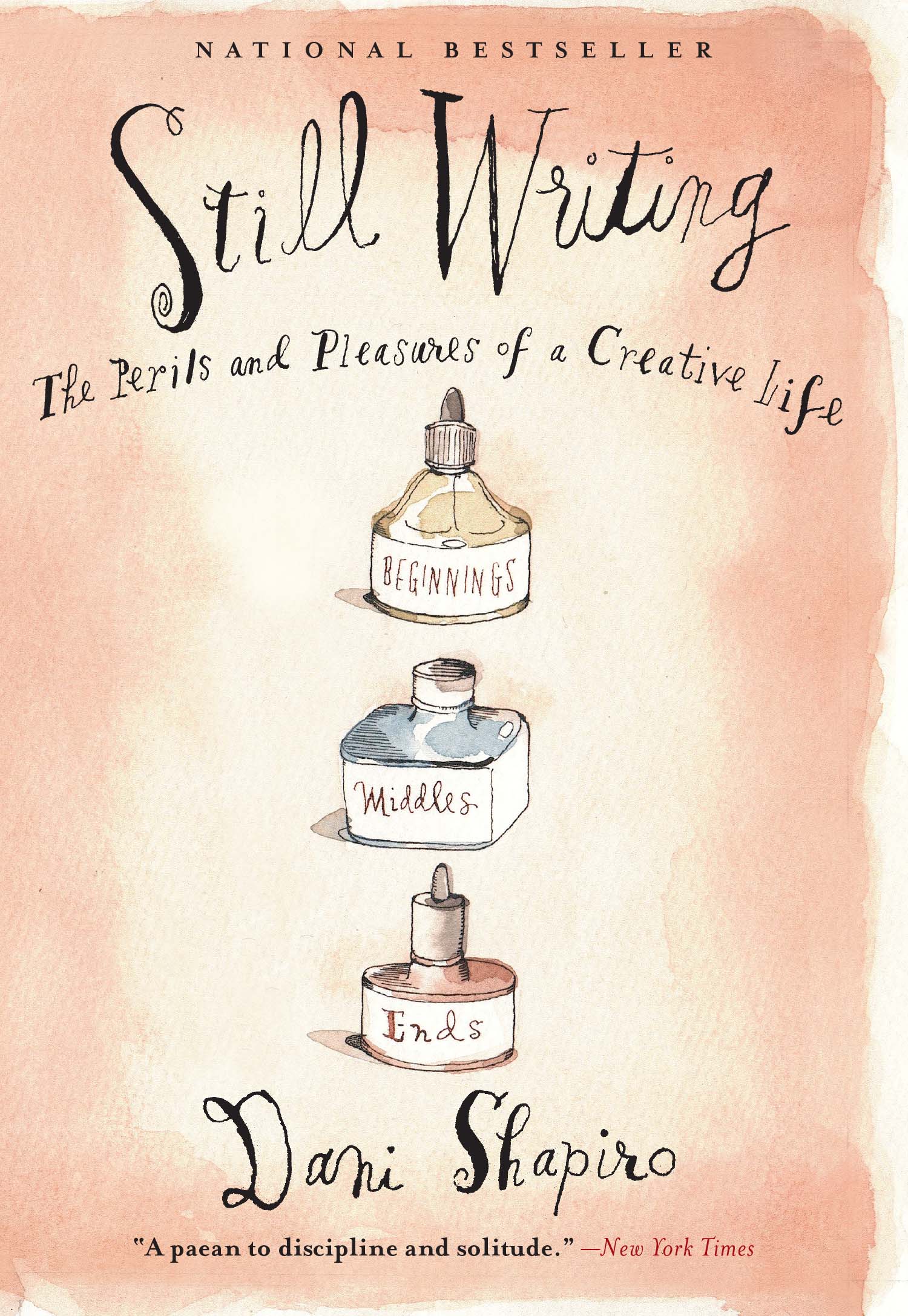
Still Writing: The Pleasures and Perils of a Creative Life

Dani Shapiro, in her book gives a deep insight into her process of writing and what it takes and gives back to her. Rather than reviewing the book, for which I don’t find myself qualified, I will be looking into how I connected with and what I learned from the book.

About

ISBN-13: 978-0-8021-2140-0 
eBook ISBN: 978-0-8021-9343-8 
Atlantic Monthly Press 
Pub Date: Oct. 1, 2013 
Category: Memoir. Biography. Self-Help 

Why I Read It?

I have been writing occasionally but I haven’t published much. Along the way I have had some good ideas on plot summaries, characters and dialogues. But when I actually wrote them, I didn’t like them as much. And what I don’t like I don’t publish. After writing many a pages of unpublished work, I started wondering how the big guys do it. What are their processes, rituals and rhythms. Do they practice and if they do, how? Do they always like what they write? Do they have a magic wand that changes garbage to gold? Do they, too, have a huge amount of unpublished work? 

I picked up ‘Still writing’ because it had the potential of providing me that insight.

First Impressions

The first impression that I got after reading the book is that writing is hard. It requires discipline to form strong habits around your process of writing. One-off inspirations can be good for short term but are never a reliable long term strategy.

I also learned that the writer has to search deep inside himself and try to bring whatever he is able to on paper. Some of these things might not be pleasant, for the reader, the people mentioned in the book or even the writer himself. Irrespective of the fact, the writer has to continue with his process of writing. 

Structure of the book

The book is divided into three sections the beginnings, the middles and the ends, co-relating with life itself. Each section has many small chapters of 2-3 pages. Depending upon the need, one can always come back and re-read a chapter or two. 

What I didn’t connect with & Why

For me it is never about the quality of the writer or his work. It is always about how I, as a reader, connect with the book in my hand. Dani has connected her writing with her life and the philosophy of life, as she understands it. She seems to be most connected with the Buddhist, Hindu and Yogi philosophies and has referred to them quite often. I never found myself connecting with any of these philosophies before, or while reading the book, as they are too cloudy and open to any sort of interpretation. So such parts of the book were least appealing to me and sometimes surprising as the writer seemed to be struggling with some basic questions for which half of the world already knows the answers of.

What I did connect with and how

Still Writing had a lot of fascinating things that I immediately understood and connected with. The overall reading experience was very good. The writing was nice, easy and fluent and the writer was able to put her points across. I took some notes on things that I was amused with and things that I want to implement in my writing as well. 

  1. Everything you need to know about life can be learned from a genuine and ongoing attempt to write. Although ‘Everything’ is a superlative which I don’t believe in pursuing through my writing, but the words that struck me the most were genuine and ongoing. If I have to write anything appealing, the effort that I make should be full of sincerity and discipline. 
  2. One word. One image. One detail. Go ahead. Then see what happens next. I often tried to start writing once the full story or a plot was in front of me, which rarely happened, and when it did happen and I wrote it out, I felt that the story sounded much better in my brain than on paper. The author tips us to focus on that one scene, one feeling, one smile. Just take care of that one small piece and then see what comes next.
  3. So much can be accomplished in one focused hour, especially when that hour is part of a routine, a sacred rhythm that becomes part of your daily life. One of the best advice that I got from James Clear’s Atomic Habits, is to embrace an identity and form a habit. Make it regular. Don’t stop. Here Dani re-enforces the same message. 
  4. There is no difference between practice and art. The practice is the art. Simply beautiful. Totally connected with it and plan to implement it.  
  5. Write for an audience of one. Doesn’t have to be alive or on the planet. Do not think about the judges on the Pulitzer Panel, or your wife or children. Write for that one imaginary person and forget about the rest. 
  6. Read the words aloud and see how they sound.
  7. Engage the five senses of the reader.
  8. Excitement —whether the happy kind or not—will make the work all but impossible. Too many times I have become too excited with what I was writing. I was seeing Pulitzers, bookers and film contracts (which I politely decline). Excitement always came in my way of some good writing. I found that my best work has always been when I was able to put all kinds of emotions and excitement aside. 

Two other things that stood out for me in the book, were

Impeccable set of instructions by the poet Jane Kenyon.

  • Protect your time.
  • Feed your inner life.
  • Avoid too much noise.
  • Read good books, have good sentences in your ears.
  • Be by yourself as often as you can.
  • Walk .
  • Take the phone off the hook.
  • Work regular hours.

And a fascinating fact about author Anthony Trollope

Anthony Trollope each time when he finished a novel. He drew a line across the page beneath his final sentence—and then he started a new one. No time to think. No time to mull over all the reasons why not. He just simply . . . kept going.

Conclusion

I have learned some exciting things from the book. Who knows if I would ever be able to find the discipline of writing a novel. But I definitely plan to use many of the above tips in writing short stories, blogs or even emails! If you want to have an insight into the process of writing, then I would definitely recommend this book, along-with ‘On Writing’ by Stephen King. 


Enjoyed reading? Join my WhatsApp Channel for daily updates and let me know what you think.